
Search

If your child has recently finished All About Reading, my first piece of advice to you is…celebrate! Have a piece of cake. Call Grandma and Grandpa. Take the rest of the day off and go to the park!
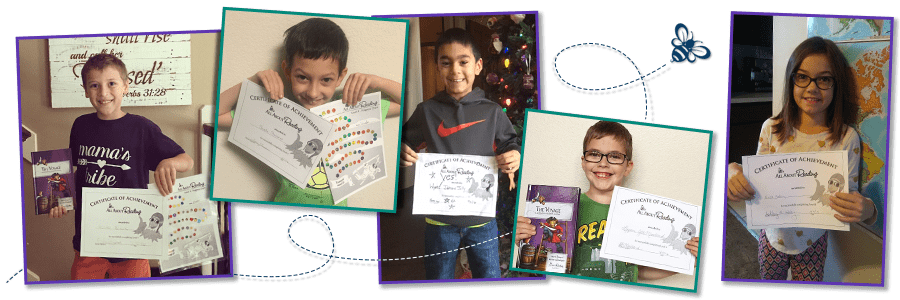
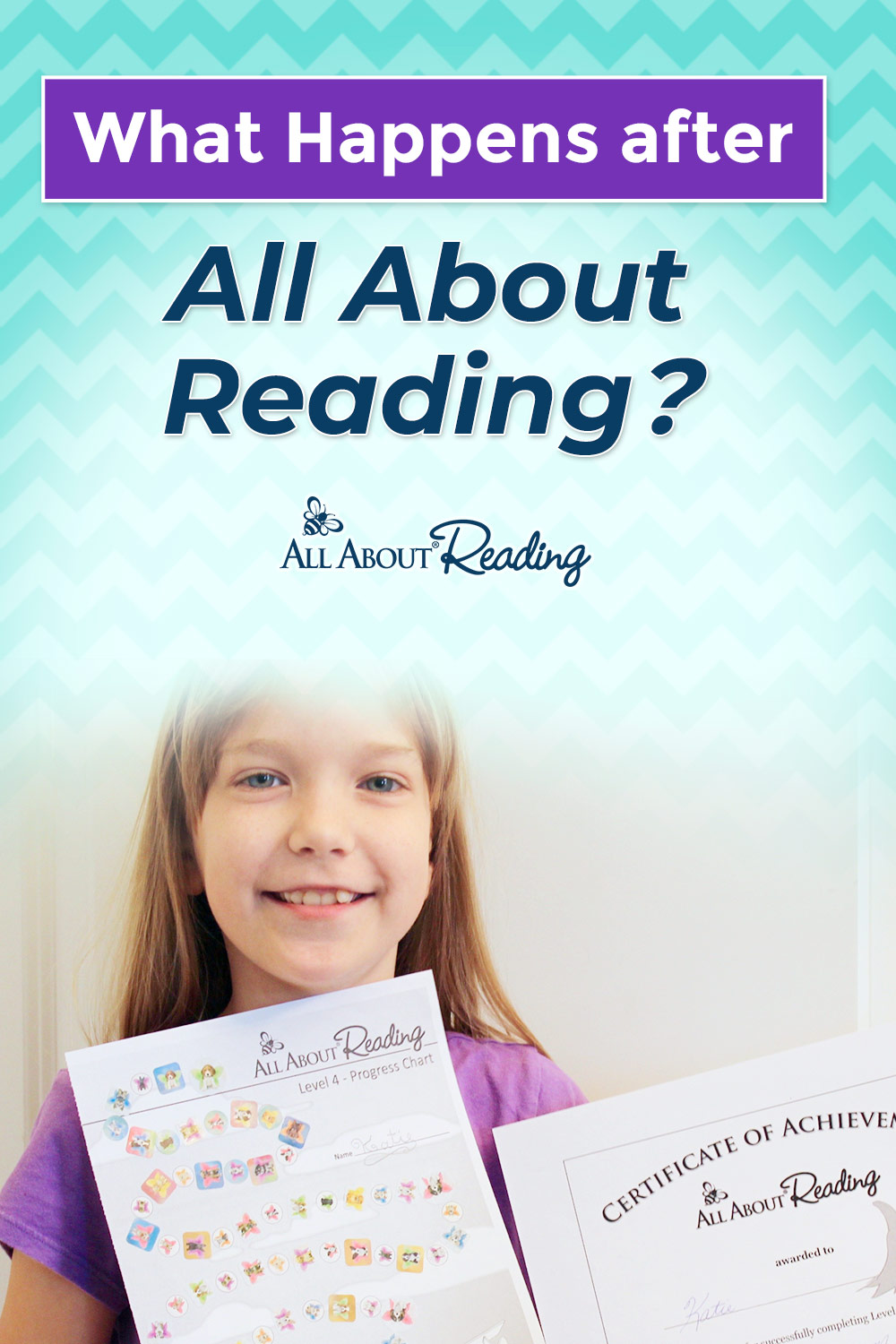
And of course, don’t forget to document this milestone and send us a photo! It makes my day when we hear from kids like Katie who complete our program! The accomplishment feels fantastic, doesn’t it?
Now your child has a rock-solid base upon which to grow in reading ability. First celebrate–then come back here for some ideas about what comes next.
Let’s take a quick look at the big picture, then we’ll dig into specifics.
There are two major stages of reading: “Learn to Read” and “Read to Learn.”
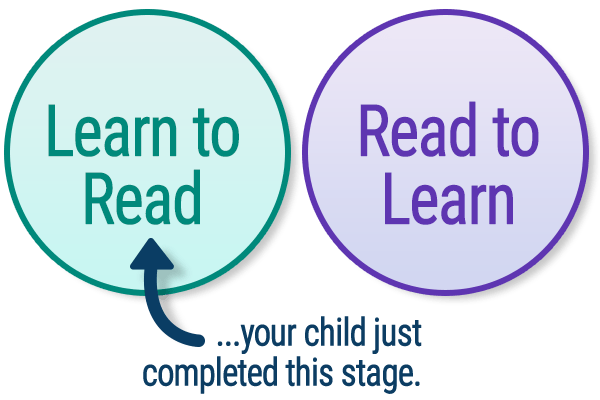
She now has the phonics and word attack skills necessary to sound out just about any familiar word. She can figure out words by dividing them into syllables, making analogies to other words, sounding out the word with the accent on different word parts, and recognizing suffixes and prefixes.
At this stage, reading is used to gain knowledge. Your child will grow in her ability to react to information and connect ideas. The possibilities for her to explore the world around her are limitless, and she can embark on this exploration through reference books, trade books, text books, magazines, and an endless array of literature. Ideally, this stage has no end; your child will “read to learn” for the rest of her school career—and beyond.
Download our Mastery Evaluation to be sure that your child has mastered the “learn to read” stage and is ready for the “read to learn” stage.
The “Read to Learn” stage does not require formal instruction like the “Learn to Read” stage does. As your child moves away from learning to read, her knowledge and vocabulary should grow and her reading should become more automatic. But that doesn’t always happen entirely on its own. You will need to be proactive to ensure that your child continues to grow as a reader and as a learner.
Help your child choose reading material that is interesting to him, both fiction (such as great chapter books) and nonfiction (such as kid-friendly magazines). For more ideas, check out resources such as Honey for a Child’s Heart by Gladys Hunt and IEW Book Recommendations (from IEW’s free download page).
For most kids, reading and being read to are the best ways to do this. But for some great practical tips, be sure to check out this comprehensive article about building your child’s vocabulary.
A study of literature is an important component of the “Read to Learn” stage, but for many kids, studying literature can easily become a “drag.” Remember, your goal during the “Read to Learn” stage is to encourage reading and to help your child continue to develop fluency and confidence, so it’s important to let your child be drawn into the joy of reading.
How do you make a study of literature more interesting? Here are a few ideas.
While encouraging your child to read independently is important, reading good literature aloud to your child is a great way to model your own thought processes. This will help your child learn to engage more effectively with what she’s reading, and will help her grow more confident in her own comprehension ability.
Whether your child reads alone or together with you, be sure that your discussions are light and natural. You’ll have a good feel for how well your child is understanding the reading as you talk with her about the book or story. Too much “analysis” can make a child dread reading, or worse, make her think she isn’t doing it “right.”
If you are looking for a more formal approach to teaching literature, here are a few literature guides our customers have found helpful.
Has your child finished All About Reading Level 4? Share a photo on Facebook or Instagram, or email it to us at [email protected]. We’d love to celebrate with you!
And if you have ideas for encouraging the “Read to Learn” stage, please share in the comments below.


Acton
says:I am looking for a complete list of the Vol. 1, 2 and 3 of the AAR books. Our learners REALLY want to check off what they’ve already done on their own! They’re so excited!
Robin E. Williams
says: Customer ServiceActon,
I love the excitement of your learners!!! Such enthusiasm is so important!
Are you looking for a list of all the stories in the Readers? The list is in the Table of Contents for each reader.
Joannikia Joannikia
says:None of your links work—- why? 404 error
Robin E. Williams
says: Customer ServiceI’m so sorry about that, Joannikia! I requested the links be fixed but it seems the team hasn’t gotten to them yet. Here are corrected links:
– Lightning Literature (from Hewitt Homeschooling) – https://hewittlearning.org/curriculum-home/lightning-lit/
– Teaching the Classics (from Institute for Excellence in Writing). Unfortunately, it looks like the product is no longer for sale.
– Essentials in Literature (from Essentials in Writing). This link is fine.
– Veritas Press Comprehension and Study Guides (recommended by Laura C.) – https://store.veritaspress.com/
– Progeny Press Study Guides (recommended by Sarah M.) – https://stores.progenypress.com/
– Moving Beyond the Page (recommended by Karen S.) – https://www.beyondthepage.com/
– Memoria Press Literature Guides (recommended by Erica F.) – https://www.memoriapress.com/literature-guides/
Keeley
says:Should a student complete all 4 levels of reading before adding in All About Spelling?
Robin E. Williams
says: Customer ServiceGood question, Keeley.
We recommend starting All About Spelling after a student has completed All About Reading Level 1 or the equivalent reading level. See our The Right Time to Start Spelling article.
Some families opt to wait to start All About Spelling until they finish all the levels of All About Reading, and it seems to work well some, but that is not what we recommend. We generally recommend starting All About Spelling while a student is working in All About Reading Level 2.
I hope this helps, but let me know if you have further questions.
Kim Robertson
says:Is it possible to start on level 2 if my child was previously public schooled? Would we miss some foundational aspects of this curriculum? I am aware and understand the placement tests. He is in first grade currently and placed starting at level 2. I am more concerned about purchasing level 1 for the sake of not having gaps but then not really needing the material at all. In addition, are there certain materials that phonogram cards that would be helpful to have on hand from level 1 that could be reviewed with starting level 2? I hope my line of questioning makes sense.
Robin
says: Customer ServiceKim,
You made perfect sense.
From what you describe, your child will do well with All About Reading Level 2. He has no need for Level 1. All About Reading Level 2 will include all of the Level 1 phonogram cards, and reviewing all of them is the very first thing done in the very first lesson! And if you would like to work on them before you received Level 2, check out our How to Teach Phonograms blog post. The Level 1 phonograms are the alphabet plus TH, SH, CH, CK, NG, and NK.
If you are concerned about gaps, I would recommend starting All About Spelling Level 1 with your child as he starts All About Reading Level 2. It will cover any rules and concepts he may have missed by not doing Level 1 of All About Reading, but with the more depth needed for spelling.
Does this clear things up for you? Let me know what additional questions you have. I’m happy to help!
Kim Robertson
says:Amazing! Thank you!
Robin
says: Customer ServiceYou’re welcome, Kim!
Chelsea Brooks
says:Any suggestions for a 7 year old starting level 4 for learning sentence structure?
Robin
says: Customer ServiceChelsea,
By sentence structure, do you mean learning to write sentences? Then I highly recommend All About Spelling. It has a gradual progression for increasing the student’s stamina and fluency in writing, from words and short phrases in Level 1, to phrases and short sentences in Level 2, to 12 dictation sentences per step in Level 3. Partway through Level 3, the Writing Station activity is introduced. In this exercise, students write sentences of their own that they make up using assigned words. In this way students have begun to use words in a more real-world context through dictation and writing, to help them transition to longer writing assignments.
On the other hand, if you are asking learning parts of speech, like verbs, nouns, and such, and clauses and so on, then you will need a grammar program. We keep a list of programs we have heard of that are incremental, multisensory, or both. You can email us at [email protected] for it.
Cristal Porter
says:Hi! We are in the same boat. Would love some resources to help with sentence structure as we come to the completion of AAR Level 4. My 9 year old also finished level 2 spelling but we will likely be starting that over as I’ve discovered many of the rules didn’t stick. Any help would be appreciated! Thank you!
Robin
says: Customer ServiceI emailed you, Cristal.
lindsay a Rodgers
says:We are just finishing up level 4! My child is still struggling in some areas. We use Beowulf grammar, and all about Spelling level 2 (about to be on level 3) Not sure where I should go from here. He is 11. Would reading chapter books with him and discussing the story/writing be sufficient? I dont need a program that has grammar. Any recommendations would be appreciated! Thank you all so much. We love All About Learning!
Robin
says: Customer ServiceLindsay,
Congratulations on nearing the end of All About Reading Level 4. Wonderful work! A world of reading is now open to your student!
It is very reasonable to set a daily reading time for your student to read for 30 minutes. Choose books that interest him, both fiction and non-fiction. You can also choose books that correlate to other subjects you are studying, such as historical fiction or Usborne books that cover science topics. This article above has several possible sources. A couple more:
– Literature-based curriculum such as Sonlight, Bookshark, Build Your Library, and others.
– The 1000 Good Books List
Have your student keep reading aloud a little each day (maybe 10 of his 30 minutes of reading), and use all of the strategies that he has learned to help him decode unfamiliar words. For students who need extra reinforcement, continue the Word Card approach and make flashcards for review using this blank Word Card Template.
Keep reading aloud to your child and enjoying great books together!
Continue with the All About Spelling program, which supports reading.
I hope this helps!
Martha
says:Can’t wait for this day!
April
says:Many of these links no longer work. As my child is working to complete All About Reading Level 4, it would be lovely to have easy access to your suggested resources.
Robin
says: Customer ServiceThank you for letting us know these links aren’t working, April! We’ll get these fixed; we’re so sorry.
Amanda
says:Hi! I could definitely use help on this area as well.
Robin
says: Customer ServiceI emailed you, Amanda.
Danae Pulaski
says:My son just started level 4 and I was going to buy the next set and I am SO sad there aren’t anymore levels. 😩 it’s been such a great building block for reading for my son. He loves to read and is doing amazingly well with your program!
Robin
says: Customer ServiceDanae,
I’m happy to hear that All About Reading helped your son learn to love to read! It is sad to come to end of it, but by that time, kids are ready to take off with reading. We don’t want to offer levels students don’t need.
Robin
says: Customer ServiceMelissa,
I’m happy to help! Look for an email from [email protected].
Tanya
says:If you are still reading thru the comments, I’m also interested in resources
Kristina
says:I would also be interested to have some resources. We’ve been using Easy Grammar to help.
Robin
says: Customer ServiceI emailed you, Kristina.
Michelle Couch
says:I would love this same information as well please.
Michelle
Robin
says: Customer ServiceMichelle,
I emailed you.
Melissa
says:Thanks so much Robin, that is extremely helpful.
Natalie
says:We have absolutely loved All About Reading as well as All About Spelling. As we are about to finish level 4 of All About Reading, I am already looking into Language Arts Curriculum. I am curious as to which “grade” level it is suggest we begin with. I am assuming we would start at a level 5 (Fifth Grade)? Any suggestions would be appreciated as far as what Curriculum and level we should start with moving forward. Thank you!
Robin
says: Customer ServiceGreat question, Natalie!
No, we do not necessarily recommend going with a 5th grade Language Arts curriculum. All About Reading Level 4 is not “4th grade.” At the end of Level 4, students have the phonics and word attack skills necessary to sound out high school-level words, though younger students may not know the meaning of all higher-level words yet. (Word attack skills include things like dividing words into syllables, making analogies to other words, sounding out the word with the accent on different word parts, recognizing affixes, etc.)
That doesn’t mean a 3rd or 4th grader is ready to read high school-level literature, of course! We find that students of all ages are generally ready to read anything that’s age-appropriate. What age or grade is your student? This is a first consideration.
Then, reach out to the maker of the curriculum you are looking at and find out what sort of skills a student should have for the grade you are looking at. Does your student have those skills?
I don’t have recommendations for all-in-one Language Arts curriculum, but I can give you ideas for writing and grammar, if you like. I think you will find our Language Arts article helpful as well.
Crystal Shumaker
says:Thank you for this! I’m not there yet but I always see people asking this question on facebook.
Heather
says:We have loved collect investigate and analyze, which is part of read side by side!
Becky H.
says:When my son finished All About Reading, I started using Word Roots from Critical Thinking Press with him. It is a good next step to continue working with prefixes and suffixes as well as vocabulary development.
Robin E.
says: Customer ServiceGreat idea, Becky! I find the study of word root meanings fascinating, and extremely helpful for building vocabulary. All About Spelling spends time on this in level 7. We have a blog post on Teaching Latin Roots with Word Trees that has printables for it as well.
Natalie
says:We are set to complete AAR level 4 within the next few weeks. My daughter and I have really loved the AAR curriculum. So easy to teach and so fun for the student. AAR gave her the tools needed to excel in reading. So amazing to see your child learn to read. She has loved the main characters associated with each level from Pluto the dog, to Froggy the frog, to Melinda the monkey, and Dusty the bird. Such a great program!
Robin E.
says: Customer ServiceThank you for sharing this, Natalie! I love that your daughter has enjoyed the animal friends in each level of All About Reading!
Congratulations on nearing the end of the program!
Carrie
says:I would love to leave a picture of my two children finishing AAR level 4 but I can not. My son loves it too much to finish. We slowed down to only do 1 lesson a week just to make it last longer. Now, he does not want to read the last story because he is so sad that it will end. We are also doing AAS but my son says he is waiting for an AAR level 5. Thank you for such a wonderful program.
Cherie
says:That is great he loves the stories so much . They are great and the illustrations are fabulous..
You could get another curriculum thst has excellent stories.
Abeka and Bob Jones does have just stories. Just get the books to read. He has the skills.
You could continue to work on comprehension as he keeps reading higher levels.
Sonlight has a lot of excellent books. You could just get the books you want from their list
Of course chapter books. Keep doing Read Alouds.
Robin E.
says: Customer ServiceCarrie,
If you wanted to email me a photo at [email protected], I’ll make sure the entire AALP sees it!
I love that your son loves All About Reading so much, but I feel bad for him that there will be no All About Reading Level 5. When a student finishes Level 4, they have learned what they need to know to be able to sound out high school level words. They are ready to go on to reading to learn and to explore all the wonderful books out there!
Jen
says:So helpful for new homeschoolers, like me.
Robin E.
says: Customer ServiceI’m glad this is helpful, Jen!
bella
says:Hi guys i am a teacher my name is Mrs. Young
Gillian
says:We are almost done with AAR 4 and I will be missing this curriculum! My daughter has such a solid grasp of reading and decoding and I am thrilled and she is so proud of how far she’s come since Level 1.
Robin E.
says: Customer ServiceCongratulations on nearing the end of All About Reading, Gillian! How exciting! I’m pleased to hear your daughter is doing so well!
Patty
says:My daughter completed all 4 levels of All About Reading and is a great reader! I wish I knew about it when I was teaching my oldest to read.
Robin E.
says: Customer ServiceCongratulations on your daughter completing all four levels, Patty! That’s quite an achievement!
Krista
says:We’re going to be starting level 1.
Robin E.
says: Customer ServiceWonderful, Krista! If you have questions as you begin or anywhere along the way, just ask! We’re happy to help.
Karrie
says:This program has been so helpful! It took away the frustration my son felt with learning to read. We are getting ready to start AAR 4 and I was wondering what steps to take next so this post is very helpful! We had started AAS but doing both seemed to confuse so we will continue on with that, but this helps guide how to keep him reading.
Robin E.
says: Customer ServiceI’m so happy to hear that All About Reading has helped your son, Karrie. I’m glad this blog post has been helpful for you in knowing what to do next as well.
KAte cOle
says:I always wondered this!
Robin E.
says: Customer ServiceGlad this helped your wondering, Kate!
Juley Adolfae
says:Really interesting post!
Robin E.
says: Customer ServiceThank you, Juley.
Jassie
says:Just purchased AAR4! We’ve thoroughly enjoyed this program!
Robin E.
says: Customer ServiceIt’s great to hear you have enjoyed All About Reading, Jassie! Thank you.
Anna Arvidson
says:We finished AAR level 4 a few years back. I am still going through withdrawals. We have one more level before completing AAS. I don’t know how I’ll handle no more box art from the shipping department.
Robin E.
says: Customer ServiceIt’s wonderful to finish, but it is sad to be done, Anna! I understand as well.
Sarah C
says:We will finish AAR4 this year and I was just thinking…what’s next? This was very helpful.
Robin E.
says: Customer ServiceI’m glad this was helpful, Sarah. However, if you have more concerns or questions as you transition to the “reading-to-learn” stage, just ask!
Eliza Burkholder
says:Thank you! What a helpful resource you are offering.
Robin E.
says: Customer ServiceYou’re welcome, Eliza.