
Search
As children learn, they add new information to what they already know. Their brains are continually reorganizing, adapting, and restructuring. Understanding how children build knowledge can help teachers and homeschooling parents adapt their lessons to make teaching more easy, effective, and fun!
As children encounter new concepts, in subjects like reading, spelling, and math, they use the things they’ve already learned to make sense of the new information. By helping them connect new concepts to real-life examples or patterns they already understand, those ideas stick far better.
In this post, we look at several ways you can organize information so your child is more likely to remember it later.
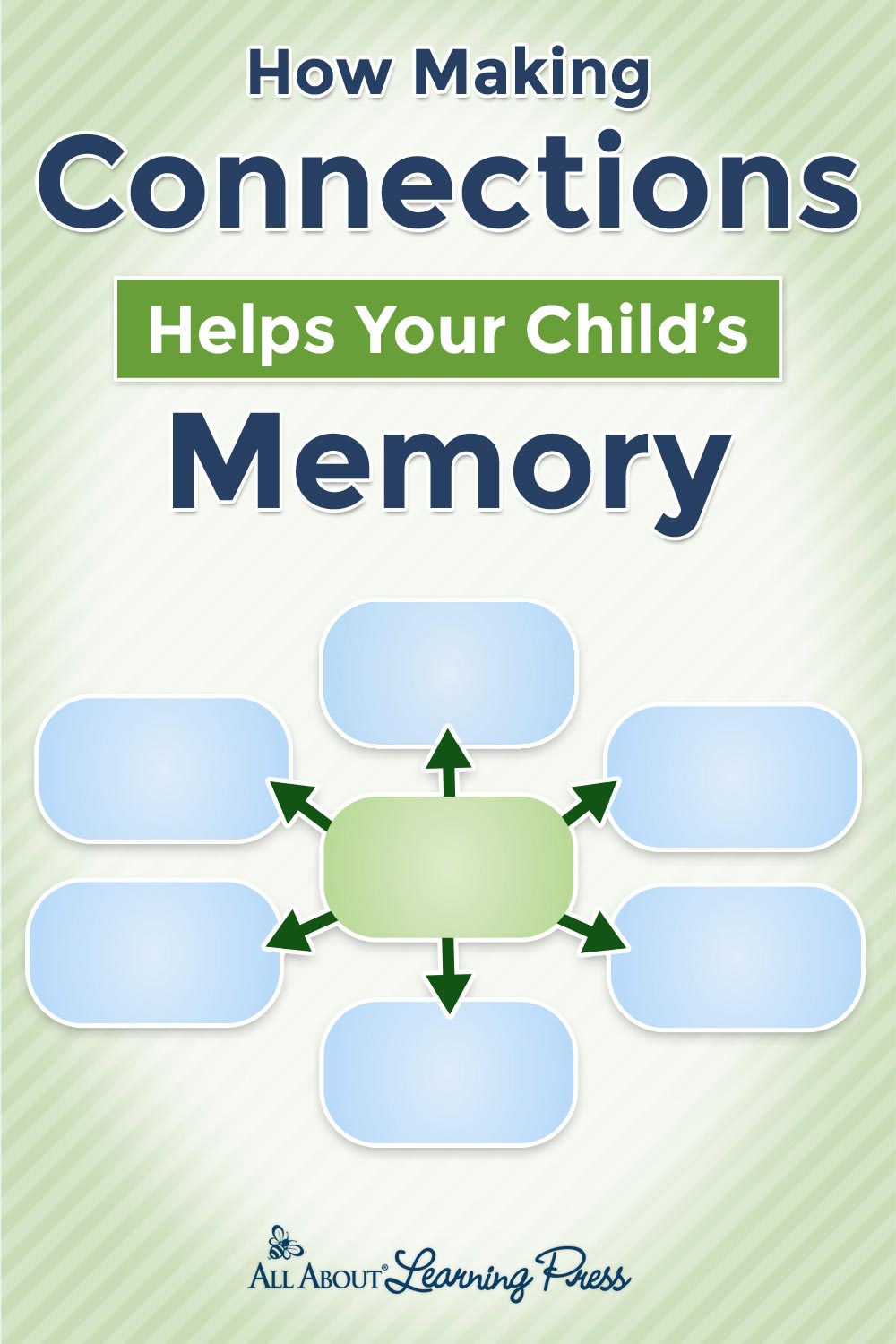
Knowledge is organized into elaborate networks called schemas. A schema is a model of how knowledge is organized and how new information is added. For example, a child may have the following schema for the alphabet:
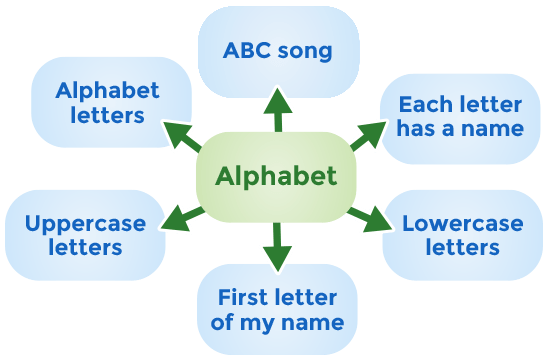
Gradually this schema becomes much more complex as the child adds more information to his knowledge base: the sounds of the letters, how to print or write cursive, which letters are vowels, and how to blend letter sounds to read words.
Each letter of the alphabet will have information attached to it. For example, a schema for the letter H might look like this:
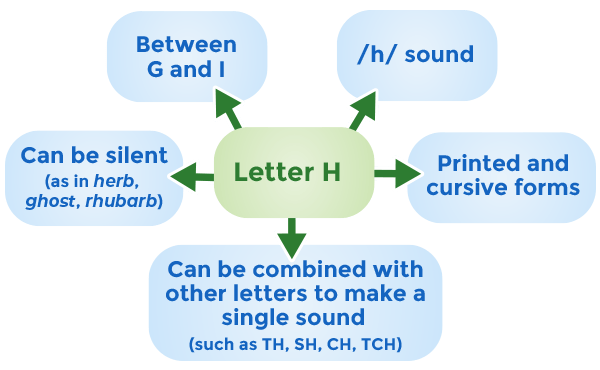
The letter H is fairly simple. The schema for vowels will be much more complex because of the wide range of sounds that a vowel can make alone and in conjunction with other letters.
This system applies to every subject children learn, and it enables them to connect the various concepts they encounter and understand them on a more intuitive level. For example, in math, students begin by learning addition, subtraction, multiplication, and division separately. However, if your child knows that 5 + 5 = 10, the schema they develop can help them see how 5 × 2 = 10 and 10 ÷ 5 = 2. Each new concept builds on their growing mental framework, making ideas easier to remember and apply.
As your child’s brain builds a schema, new information is attached to previously stored information. Although we can’t show it through a simple drawing, the number of connections between pieces of information is unlimited since multiple ideas and concepts can be intricately interconnected. Watch this video for a 30-second demonstration.
If there is nothing to relate the new information to, there is no way for it to be stored in long-term memory. Instead, it is dropped from short-term memory and completely forgotten. If someone talks to you in Russian, and you don’t speak Russian, there is nothing for that information to connect to, and the information is dropped.
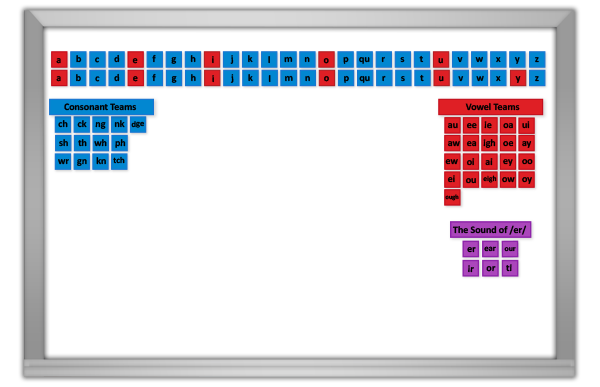
All About Reading, All About Spelling, and All About Math help your child build an efficient schema or network of knowledge. Here are three important ways our programs help organize information:
Subjects like math and science allow your child to connect the concepts they’re learning to the real world. For example, counting objects, measuring ingredients, comparing prices, or cutting a pizza into slices give meaning to addition, subtraction, multiplication, division, and fractions. Geometry can be linked to shapes children see in buildings or art. Ultimately, when school subjects feel meaningful, they become memorable.
The same technique is also extremely useful in clarifying abstract math concepts. For example, you might compare regrouping in subtraction to exchanging money, like if you don’t have enough one-dollar bills and need to get change for a ten. You can also use manipulatives, like building blocks, which can be stacked and grouped to illustrate concepts like place values. Simple analogies and hands-on activities turn abstract numbers into something your child can relate to and understand, transforming the act of learning from pure memorization into something intuitive.

In All About Math, unifying themes help children see how math concepts build on one another. For example, grouping lessons around a theme of patterns and relationships can tie together multiplication, skip counting, and arrays. Even in everyday review, linking concepts, like addition and subtraction as opposites, helps build a bigger picture of how math works.
By helping your child build an organized schema, you’ll be helping her build her long-term memory. Each new bit of information will have a logical place to connect to, and your teaching will be more effective.
Download my free e-book “Help Your Child’s Memory” to learn more techniques to help strengthen your child’s memory and achieve learning that really sticks.


roza zerraf
says:Roza
Hello , thank you for sharing . I ll try to work with your methods .
Robin
says: Customer ServiceYou’re welcome. Let me know if you have any questions. I’m happy to help!
Robin
says: Customer ServiceThank you for sharing, Susan.
JoAnn Mastrosimone
says:I love all the help this website suggests to help students become better learners.
Robin
says: Customer ServiceThank you, JoAnn! It’s great to hear.
Antoinette Allen
says:My daughter is in the 4th grade. How do you start from there?
Robin E.
says: Customer ServiceAntoinette,
I’m happy to help you with placement. Are you interested in the All About Spelling program or the All About Reading program, or both? We have placement tests, but let me know if you have questions or need additional help.
Lisa Toleno
says:This sounds very similar to Herbert’s Apperception masses. I was just reading David Kilpatrick’s Equipped for Reading Success. The key to letter sound recognition has to do with the oral/auditory dictionary of words that are stored in the long-term memory of our brains. The words represent meaning/ideas. Without meaning, none of this ancillary information about the letters sticks. Without using the auditory sense, the visual memory is unable to store the written/printed words in long-term memory. All quite fascinating.
Robin E.
says: Customer ServiceVery interesting! Thank you for sharing this, Lisa.
Beth A. Baker
says:I so appreciate these valuable posts of practical information and strategies. This particular one on schema has helped jar my memory about learning. I can use this information tomorrow. Thank you.
valentina guerrini
says:Thank you, I am looking forward to implement all the tips in E book.
Robin E.
says: Customer ServiceYou’re welcome, Valentina! I hope the ebook helps your student or students a lot.
Erin Miller
says:Thank you so much for this ebook and all of the information in it! I’m learning so much from this, so in turn, I will be able to teach my children with confidence!
Robin E.
says: Customer ServiceYou’re welcome, Erin! I’m pleased to hear that this will help you have confidence in teaching your children.
Steve W.
says:My child suffers from poor working memory and this was very helpful in teaching me how to help her. We ordered Headbanz and learned a few more techniques from the ebook. Thank you so much for guiding us in the right direction to the best ways to help our children. My 8-year-old has more confidence in reading and it is branching off into other aspects of her life.
Robin E.
says: Customer ServiceThis is so great to hear, Steve! I love that your 8-year-old is more confident and is branching out. That’s what learning should be about! Thank you for letting us know about her success.
Sabriya
says:These are great tips to boost learning and creating new schema.
Robin E.
says: Customer ServiceThank you, Sabriya.
Jennifer
says:Wow this is so helpful
Sarah
says:Very helpful. I loved the graphic organizers.
Laura
says:Love the process of this program.
Robin E.
says: Customer ServiceThank you, Laura!
M Ng
says:This concept of helping children build schemas is helpful. I Mom forward to reading more articles on this site.
Jennifer Hess
says:So excited to start helping my grandkids learn,
Rae-Ann Casillas
says:Wow! It amazed me to learn here and tips to help my child understand! When its just something that mt brain already gets.
Sara
says:can’t wait for my level 1 to come in!
Robin E.
says: Customer ServiceSara,
Level 1 of All About Reading and All About Spelling are currently available and in stock.
Kim
says:Awesome multi sensory resources. Appreciate the free resources!
Robin E.
says: Customer ServiceYou are so welcome, Kim!
Evangeline Mitchem
says:Your program sounds very good. I need to remember this to help my children know what sounds these letters make.
Carol
says:Thank you! This is so helpful in learning sounds.
Heather C
says:Great tips for helping them remember! Connections!
Heather
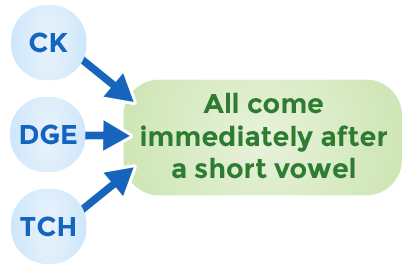
says:I definitely need to remember the tip about connecting info to things they already know. The CK/DGE/TCH after a short vowel! Ah-ha!
Robin E.
says: Customer ServiceHeather,
Yes! That pattern was an eyeopener for me too. There are a handful of short vowel words that do not use TCH that are common (much and such, for example), but otherwise the pattern holds for all three phonograms.
Stephanie M
says:So many good things in this article. This website has been a blessing!
Jennefer
says:Lots of good tips! I’ll be putting them to use!
Faith Yoder
says:Love this info!
Audra
says:Love the free resources!
Sara
says:I love the resources on this site and I am excited to begin using AAR soon with my daughter!
Jenny S.
says:I am reviewing this All About Reading for my grandson. We are beginning home school and he is so excited! I think I have found the program to keep him excited about learning to read!
Ingrid
says:I am very interested in the All About Reading. I have a struggling grade 4 student. I am currently using an OG program but it is bland and I feel she is bored. I look forward to testing her this fall and seeing which level she fits into.
Thank you!
Robin E.
says: Customer ServiceGreat to hear, Ingrid! Let me know if you have any questions about placement or anything else.
christi w
says:So many things I did not know myself and am learning right along my kiddos