


The American Homeschool Attainability Index
For the first time, the top states for home-based education are rated by what really matters to families — the autonomy to teach your way, communities that have your back, and the growth rate that shows homeschooling is anything but an isolated choice.
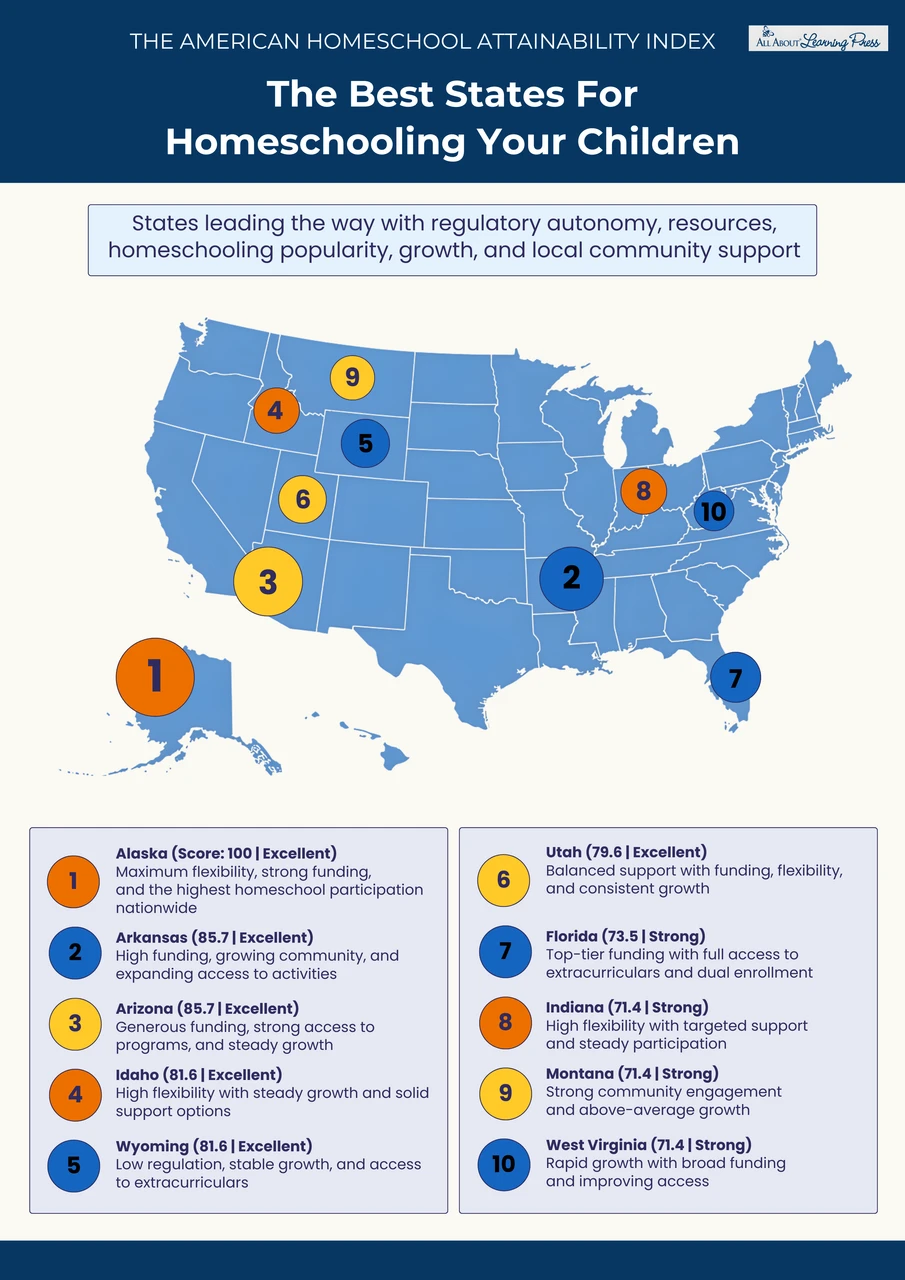
The 10 Best States for Homeschooling in America
Home education has become a growing and well-established part of the American education landscape, with around 3.4 million K–12 students learning at home in 2024–2025 [1]. For many households, it offers the flexibility to shape learning around their child's needs, interests, and pace.
What does a great homeschooling environment actually look like? The most welcoming communities combine the autonomy to get started easily, resources that help parents make the most of learning at home, state requirements that are homeschool-friendly, connections that keep families supported, and rising numbers of homeschoolers that reflect how far home education has come.
All About Learning Press took a close look at every state to find where homeschooling families are best supported, weighing the factors that make a real, day-to-day difference.
The result is the American Homeschool Attainability Index: a look at ten of the states where home education is thriving. Rather than ranking all 50 states, we focused on spotlighting the places where parents are finding the right mix of autonomy, resources & support, and community to make homeschooling as successful as possible.
Todd Thorpe, Head of Homeschool at All About Learning Press, Inc.:
"Many students flourish in homeschooling — often more than in traditional schools. The biggest barrier hasn't been a lack of interest but finding the right conditions to participate. Is there a supportive community for our family? Can I find the right support to follow through? Our analysis shows that the top states in our index are creating that foundation, lowering structural barriers, and enabling more Americans to make the best educational choice for their kids."
How We Identified the Top 10
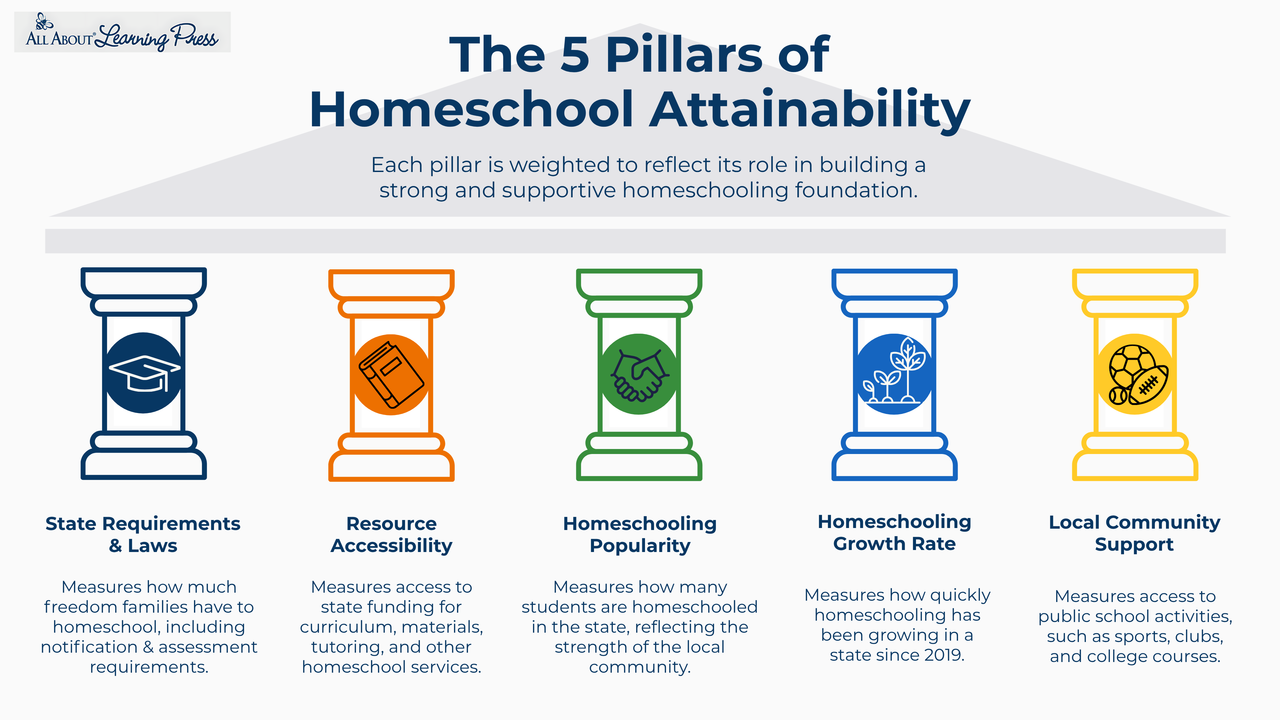
To identify the best states for homeschooling, we evaluated all 50 states across five key pillars that reflect what parents care about most when choosing to educate at home. Each state received a score from 1 to 4 for each pillar. The higher the score, the more welcoming homeschooling is for families.
This framework captures the conditions that matter most: state requirements & laws, access to funding and resources, supportive communities, and the growth of homeschooling in that region. The infographic below provides a closer look at the five pillars and how each factor shapes a state's overall score.
Full methodology and sources are available below.
Alaska Offers The Best Environment For Homeschooling
Score: 100
Alaskan homeschoolers have built one of the most self-reliant education cultures in the country. Long before home education became a national conversation, households across Alaska's remote communities were finding their own way, and that spirit never left. Today, 16.1% of Alaska's K–12 students learn at home, the highest rate in the nation, with growth of 13.3 percentage points since 2019.
Families here have real choices: dive in independently with no requirements whatsoever, or plug into a network of support programs that offer curriculum guidance and community backup. Either way, homeschoolers have full access to extracurriculars and dual enrollment. Alaska's homeschooling community didn't wait for permission to thrive. They built something that the rest of the country is still catching up to.
Alaska homeschooling requirements at a glance:
- No notice, registration, approval, or paperwork required for independent homeschooling
- Parents need no teaching credentials, diplomas, or certifications
- No mandatory curriculum, standardized testing, or assessments at any grade level
#2 — Arkansas · Score: 86
Quietly and steadily, Arkansas has become one of the South's most welcoming places for homeschooling families. A simple annual notice is all it takes to get started. After that, families choose their own curriculum, set their own schedule, and teach on their own terms. No standardized testing, no outside oversight. That freedom has attracted a growing wave of homeschoolers, with 7.5% of students now learning at home, and some rural counties showing especially strong participation. Here, homeschooling isn't a workaround. It's a well-worn path with plenty of company along the way.
Arkansas homeschooling requirements at a glance:
- Annual notice of intent must be filed with the local school district, including a waiver of state liability
- Parents must hold a high school diploma or GED
- No standardized testing or curriculum requirements; instruction is parent-directed
#3 — Arizona · Score: 86
Few states have had as long to get this right as Arizona, and it shows. Home education has been part of everyday Arizona life since 1982, and the community that's grown up around it reflects that maturity. One simple affidavit is all families need to get started. From there, the world opens up: full access to extracurriculars, dual enrollment, and a diverse, well-organized network of co-ops and learning groups. With 6.9% of K–12 students homeschooling and that number still climbing, Arizona is one of the most established and welcoming homeschooling communities in the country.
Arizona homeschooling requirements at a glance:
- A one-time affidavit must be filed with the county school superintendent to begin homeschooling
- Instruction must be provided in English and include required core subjects (reading, grammar, mathematics, social studies, and science)
- No standardized testing, portfolio reviews, or curriculum mandates beyond subject coverage
#4 — Idaho · Score: 82
Idaho's homeschoolers don't need much guidance from any external providers, and that's exactly how they like it. There's no notice to file, no curriculum to follow, no testing to prepare for. Families simply start, and a strong local community is there to meet them. Nearly 6% of Idaho students currently learn at home, with steady growth that reflects something deeper than a trend: a genuine culture of educational independence that's been part of Idaho family life for a long time.
Idaho homeschooling requirements at a glance:
- No registration, notice, or approval required to begin homeschooling
- No standardized testing or mandatory curriculum
- Instruction must be comparable to that provided in public schools, including commonly taught subjects, which include language arts, math, science, and social studies
#5 — Wyoming · Score: 82
Homeschoolers in Wyoming have turned wide-open spaces into a tight-knit community, and it works beautifully. Families start without any formalities and teach entirely on their own terms. What makes Wyoming stand out is how well-connected that independence feels: local networks are active, co-ops are flourishing, and networks regularly find each other across the state's vast geography. With 5.2% of students homeschooled and consistent growth since 2019, Wyoming's community has quietly become one of the Mountain West's best-kept secrets.
Wyoming homeschooling requirements at a glance:
- An annual curriculum must be submitted to the local school district
- Instruction must cover required core subjects (reading, writing, mathematics, civics, history, and literature)
- No standardized testing or external assessments mandated
#6 — Utah · Score: 80
Utah's homeschooling network has something that is hard to manufacture: genuine community. Between well-organized co-ops, faith-based networks, and a culture that puts family at the center of everything, homeschooling here rarely feels like going it alone. Parents file a simple notification and are free to build from there. With 4.8% of students learning at home and steady growth since 2019, Utah's homeschooling community is one of the most connected and mutually supportive in the country.
Utah homeschooling requirements at a glance:
- A one-time affidavit must be submitted to the local school board to establish homeschooling status
- No standardized testing requirements or curriculum mandates
- Parents have full freedom over materials, schedule, and teaching approach
#7 — Florida · Score: 74
When it comes to resources and reach, few homeschooling communities come close to Florida's. Parents work within a clear framework, with an annual notice and periodic assessments, but the trade-off is access to a rich ecosystem of extracurriculars, dual enrollment, and shared programs. More than 5% of Florida students now homeschool, and the broader education community has started to take notice. Public school districts have begun offering part-time services to homeschooling families, a sign of just how established home education has become in everyday Florida life.
Florida homeschooling requirements at a glance:
- Annual notice of intent required with the local school district superintendent
- Students must undergo an annual evaluation, with several options available including standardized testing or portfolio review
- Families must cover a set of required subjects, though curriculum choices remain up to the parent
#8 — Indiana · Score: 71
No notice, no set curriculum, no standardized testing. In Indiana, getting started is as simple as deciding to start. A deep network of active co-ops and like-minded families is there to welcome newcomers from day one. Over 5% of Indiana students are homeschooled, supported by one of the Midwest's most engaged homeschooling cultures. For parents who lead with autonomy and want a community that shares that value, Indiana fits like a glove.
Indiana homeschooling requirements at a glance:
- No notice, registration, or government approval required
- No standardized testing or assessment mandates, but parents must keep attendance records
- Homeschools must operate as non-public schools and provide instruction equivalent to that offered in public schools
#9 — Montana · Score: 71
Spread out across one of the country's most expansive landscapes, Montana's homeschoolers have turned distance into creativity. Co-ops and shared learning groups have taken root across the state, with parents finding inventive ways to connect, collaborate, and support each other across the miles. With 9% of students learning at home and 6.2 percentage points of growth since 2019, this is among the fastest-growing and most vibrant homeschooling communities in the nation.
Montana homeschooling requirements at a glance:
- An annual notice must be filed with the county superintendent of schools
- Instruction must cover required core subjects, with curriculum chosen by the parent
- No standardized testing required, but families must maintain attendance records and provide immunization records or a valid exemption
#10 — West Virginia · Score: 71
Something remarkable is happening in West Virginia. With 8.9% of students now learning at home and 6.1 percentage points of growth since 2019, communities across all 55 counties are expanding fast. Homeschoolers here have access to solid financial support and extracurricular programs, but the real story is the people: a grassroots community that's grown quickly, built real infrastructure, and shows no signs of slowing down. West Virginia is one of the most exciting homeschooling stories in the country right now.
West Virginia homeschooling requirements at a glance:
- Annual notice of intent required, along with evidence of the teaching parent's qualifications (high school diploma or higher)
- Students must complete an annual assessment, such as a standardized test or evaluation by a certified teacher
- Instruction must cover a defined set of core subjects each year
The Homeschool Attainability Index shows that while opportunities vary from state to state, homeschooling is thriving across the nation. Families are turning independence into achievement, supported by connected communities, access to resources, and the autonomy to shape learning at home.
Sources
[1] National Home Education Research Institute: Fast Facts on Homeschooling
Methodology
Finding the top 10 meant looking at all 50 states through the same lens: five evidence-based pillars that reflect the autonomy, community, and support that make homeschooling genuinely work for families, with the objective of identifying and recognizing the ten states that perform best overall. All states were scored across five evidence-based pillars:
- State Requirements & Laws (30%) — The degree of regulatory autonomy available to homeschooling families, including notice, curriculum, and testing requirements.
- Resource Accessibility (25%) — The availability of state-funded or nonprofit financial support for curriculum, materials, and educational services.
- Homeschooling Popularity (20%) — The strength and density of local homeschooling networks and peer support infrastructure.
- Homeschooling Growth Rate (10%) — Growth in home-based education enrollment since the 2019 baseline.
- Local Community Support (15%) — The extent to which homeschooled students can access public school extracurriculars and dual enrollment programs.
Each pillar is scored from 1 to 4, weighted by its importance, and combined into a composite 0–100 attainability score. The ten states with the highest scores are recognized in this index. All data come from the most current publicly available sources (March 2026), including federal and state education reports, nonprofit program data, and household surveys. For a full breakdown of the ranking, sources, scoring keys, and pillar definitions, download the complete methodology PDF.