
Search
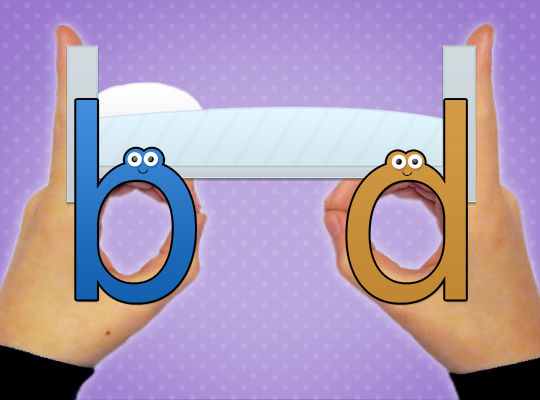
It is easy to see how letter reversals happen: flip the b and it becomes a d. The beginning reader or dyslexic child may not realize that the direction of the letter matters, or he may not be able to remember which letter is which.
Letters that are mirror images of each other are more likely to be confused, including letters b and d, p and d, p and q, and n and u.
Fortunately, most of the letters of the alphabet have unique shapes, so no matter which way you turn them, they can’t be confused with any others. For example, the letter m looks quite different from the letter x, and f is not likely to be confused with the letter z.
If your child is between the ages of three and seven, is just starting to read, and makes occasional letter reversals when reading or writing, it’s perfectly normal. It doesn’t mean that your child has dyslexia or a reading disability. Make a gentle correction and move on.
But if your child is eight years or older, has had prior reading instruction, and makes frequent reversal errors, it is important to take action to solve the letter confusion.
As reading instructors, we have two jobs to do regarding letter reversals:
The All About Reading program is carefully structured to minimize the likelihood of letter reversals. We teach the sounds of potentially confusing letters like b and d in separate lessons. The child’s task is simplified because he only has to make one new visual discrimination at a time.
When your child is learning to print, be sure to teach correct letter formation. Doing so is critical to prevent confusion.
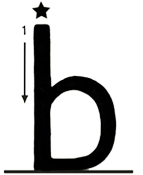
When forming the letter b, start with the stick first, followed by the circle. The star indicates the starting position.
To write the letter d, start with the circle first, followed by the stick. Again, the star indicates the starting position.
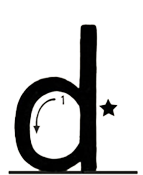
Have your child use lined paper so it is clear where the circle is in relation to the stick. Also be sure your student does not lift the pencil from the paper when writing any of the confusable letters.
If you are working with older learners, it may be too late to prevent confusion. They may have had a few false starts in reading, and may have already confused these troublemakers. They may encounter the letter b and misinterpret it as the letter d. They may read the word bad as dab, or fad as fab. You might give a gentle correction, pull out the corresponding Phonogram Cards, and re-teach the letters separately, but your student still mixes them up. If that is the case, read on to discover four effective methods to solve the problem.
The demonstrations below are for correcting b and d reversals (the most common letter reversals), but the same concepts can be applied to any letter or number. You may only need to use one of these methods, but for really resistant cases, you will need to use all four methods.
Please note that it’s important to concentrate on just one letter per session. Wait until that letter is completely mastered before teaching another letter.
Have a variety of tactile surfaces for your child to choose from. Possibilities include flannel fabric, corrugated cardboard, very fine sandpaper, fluffy fur fabric, or a carpet square. Ask him which surface reminds him of the letter b, and then cut a large lowercase b out of the chosen tactile surface.
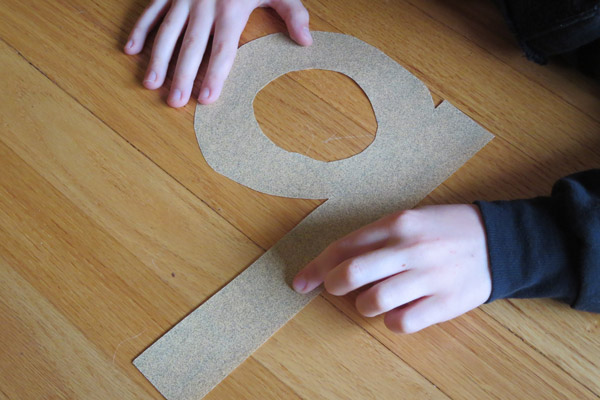
Using the pointer finger of his dominant hand, have your child trace the letter b on the textured surface. Be sure that he starts and ends in the correct place. Practice until he can easily write the letter b.
When your child is ready to go on to a new letter, choose a different textured surface. If fine sandpaper was used for the letter b, perhaps furry fabric can be used for the letter d.
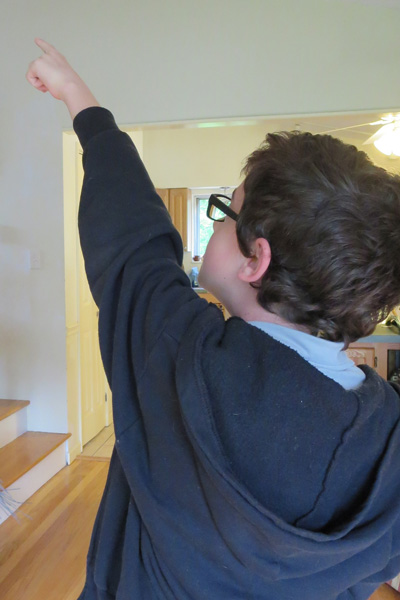
Another powerful method for correcting letter reversals is “air writing.” Air writing is simple: using the dominant hand, the child uses his entire arm to write letters in the air as he says the sound of the letter. The whole arm should be involved, and the child should pretend that his pointer finger is a pen.
Here, Jimmy demonstrates for us how to use air writing to form the letter b. Notice that his whole arm is involved in order to activate large muscles. He is pretending that his pointer finger is a pen. While he forms the letter b with his arm, he is saying the sound of the letter, /b/.
Brain research shows that two ideas practiced at the same time can permanently bond the ideas together. In this case, the large movements of the arm combined with saying the sound of the letter helps link these two concepts together in your child’s brain.
Additionally, this multisensory activity takes advantage of the fact that the muscles in the shoulder and in the jaw have muscle memory, and this makes it easier for your child to recall the shape and sound of the letter.
Explain that the letter b is made up of two shapes: a bat and a ball. Using the tactile surface, demonstrate how you write the bat part of the letter first, followed by the ball.
As you write the letter b, say “bat-ball-/b/,” like this:

To further clarify which side of the letter the straight line is on, tell your student, First you grab the bat, then you hit the ball. Have your student practice this motion and chant many times over a two-minute time period. Show your student that when you are reading from left to right, you encounter the bat part of the letter first. If he is ever unsure of the sound this letter makes when he sees it, he should think to himself, “bat-ball-/b/.” This will help him recall the sound of the letter b. Repeat the exercise several times a day.
To teach the letter d, you can use the analogy of a doorknob and a door. The doorknob represents the circle part of the letter, and the door represents the straight line, like this:

To clarify which side of the letter the straight line is on, tell your student, First you grab the doorknob, then you open the door. Again, practice the motion and chant many times over a two-minute period. Show your student that when you are reading from left to right, you encounter the doorknob part of the letter first. If he is ever unsure of the sound this letter makes when he sees it, he should think to himself, “doorknob-door-/d/.” He will now be able to recall the sound of the letter d. (Download our How to Solve Letter Reversals report for printable bat/ball and doorknob/door graphics.) Repeat the exercise several times a day.
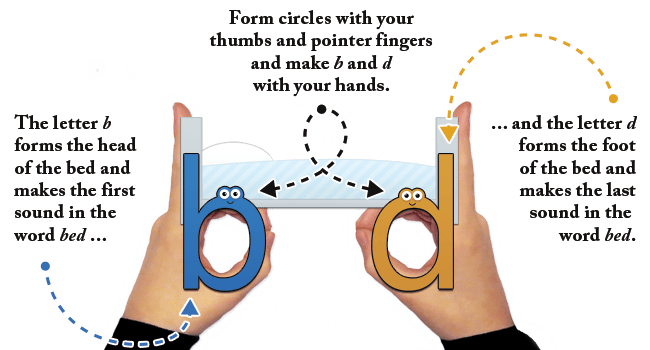
A common analogy to help with b and d confusion is a bed. Though this analogy may help some kids, for others it may require more thought, and for many kids it may not become automatic.
When we say /b/, our lips come together in a straight line. Point out that the straight line comes first when you write the letter b.

When we say /d/, our lips are open. Coincidentally, the circle comes first when you write letter d.

If your child mistakes a b for a d while reading, refer back to the tactile surface activity and air writing that you did together. Point to the misread letter and say, If you wrote this letter, what would this letter say?
If your child can’t answer easily, ask him or her to draw the letter b using air writing. The sound of the letter (/b/- bat) should come more easily this way. Then have your child read the word again.
This free e-book illustrates the four methods outlined here, plus it has two printable charts to help you correct b and d reversals.
When students have persistent reversals, reading becomes a struggle and it can be difficult for them to express themselves in writing. You can put an end to that struggle with the information shared in this report!
Have you discovered a helpful strategy for dealing with letter reversal issues? Please share in the comments below.



Carly
says:Pretty consistently when writing my 7.5 year old son writes letters and numbers backward- not the easy to confuse letters, EVERYTHING. Or random letters and numbers. It seems bizarre to me because I taught him specific letter formation, air writing, tactile letter formation, and he’s a great reader- flying through level 3. I notice it happens more when he’s tired? Is this indicative of anything specific? I will check out the e book for additional strategies to support him.
Robin
says: Customer ServiceCarly,
Great observation noticing that reversals happen more when your son is tired. That is indicative that when he is tired it’s harder to focus. Everyone has more trouble with stuff when they are tired!
When babies are first experiencing the world, they have to learn that an object is still the same object no matter what direction it is facing. A chair is a chair is a chair no matter if it is facing left, right, or upside down! Then, when learning letters and numbers, children learn for the first time that something is no longer the same if you face it the other way. No wonder kids have trouble with writing letters and numbers backward! There is nothing in their life experience up to that point that is impacted by directionality like letters and numbers are.
Consider giving him a cheat sheet that has all the letters and numbers written correctly. Then he can quickly look and verify directionality before writing. And, if he does write a letter or number backward, have him find and correct it. Don’t rush in to point out a backward letter or number immediately. What until he has written a few words or done a line of math problems. Then point out he wrote one backward and ask if he can find it and fix it. Only provide more direct help if he can’t find it himself.
Once he can find his errors easily when you let him know there is one, start asking him if he has written all the letters (or numbers) in the correct direction. Occasionally ask even if he has written everything correctly. At that point you are wanting him to start assessing his own writing, so you have to give him a chance to do it both when there is an error and when there is not.
And watch him with the cheat sheet over time. Once you notice he doesn’t use it as much, have him lay it face down. He can flip it and look at it if needed, but that will be just that tiny bit more incentive to not look.
In time he will get directionality. But let me know what additional questions and concerns you have. I’m happy to help!
Carly
says:Thank you for such a thoughtful and helpful response!
Robin
says: Customer ServiceYou are so welcome, Carly! And thank you for taking the time to reply. I sometimes wonder if my responses on blog questions get seen.
Juliana
says:My daughter (7.5) has consistently had problems confusing “b” and “p”. She no longer confuses “d” but those two have been hard to correct. I’ve tried the analogies and little tricks and she is improving but it’s still a frustration for both of us. I hear all sorts of recommendations for “b” and “d” confusion but do you have any recommendations for getting the “b” and “p” confusion to click? I’ll try out the air writing next. Thank you!
Robin
says: Customer ServiceJuliana,
Flipping b and p is probably the second most common letter reversal confusion for children. Up and down directionality for letters can be as difficult as left and right, and b and p are especially troublesome because they make almost the same sound. The /b/ sound is basically the voiced /p/ sound (“voiced” means the vocal cords vibrate, you can feel the difference if you say both sounds with your hand on your throat).
Try working on just one letter of a confused pair at a time. If you work on both b and p each day or even in the same week, the confusion can be made worse, not better. Work on p first, as it is slightly more frequently used in English than b is.
First, do this:
– Prepare a transparent sheet of plastic such as a binder sheet protector or see-through placement by printing a large p on it. Stand your child in front of you, facing the p. Have your child point the way the p points. Her arm should be fully extended straight down. Ask, “What are you pointing at?” She’ll say the floor or whatever. Keeping her arm pointing down, turn a quarter turn. “Now, what are you pointing at?”
– Then have her lie down and point where the p points. “Now, what are you pointing at?” Maybe it’s the door. Then have her turn a quarter turn while continuing to lie down. What is she pointing to now? If she is up to it, you could even have her stand on her head and see where the p points! (Keep the p sheet in the correct direction in relation to her body, as if she were standing.)
– Discuss that the only constant is your child’s body. The p always points down to her toes. She is the important thing! All directional concepts with letters, numbers, and words must relate to the body; the body only constant.
– After lots of pointing around the room and in different places, present a toe ring, an ankle bracelet, or a stamp on your child’s foot or toe. Say, “This is your p direction.” Have her show you her p direction by pointing to her foot a few times throughout the day.
Each day, review with the see-through p sheet and and your child’s p direction. Make a tactile letter p and do airwriting of p while saying /p/. After the first day with the see-through sheet, reviewing p should only take 3 or so minutes (although it will take more time to make a tactile letter p). You could add “P /p/-/p/-/p/-points to my /p/-/p/-/p/-pinkie toe!” Tracing the tactile letter and doing airwriting while saying /p/ each time can seem “young,” but do it anyway. These are very effective activities for solidifying letter directionality and sound!
After a couple of weeks of focusing on p, do a transparent sheet for b. She should point up for it, and a saying could be “B aims at my /b/-/b/-/b/-brow!” Do a tactile letter and the airwriting for b, spending a week or so just on it.
I look forward to hearing that this helps your daughter finally master these letters!
Mahrukh
says:Children find it difficult to differentiate the sounds of /t/ and /d/
How can we explain this to the child even after we show them how the sounds are made.
Thank you
Robin
says: Customer ServiceI’m sorry your children are having trouble with these sounds, Mahrukh. The confusion is understandable, because they are basically the same sound except /d/ is voiced and /t/ is not. “Voiced” means the vocal cords vibrate with the sound. You can feel /d/ if you place your hand on your throat, but not /t/.
It’s also probably not helpful that T can sometimes take on a /d/ sound, such as how words like little and metal are pronounced in many accents. And ED can say /t/ in some past tense words like passed and helped.
Are your children not able to hear the difference between the sounds, or do you mean they are confusing which sound goes to which letter? If they can’t hear the sounds, then working on hearing them. Check out this video by Rachel’s English. It may be helpful for you in teaching the sounds, but it’s a bit too detailed for most children. Practice having them hear the sounds by having them listen and then repeat minimal pair words. These are words that have all the same sounds except for the sounds you are targeting. So, bed/bet, pat/pad, dime/time, dub/tub, to/do, sight/side. Two syllable minimal pairs are fine too, like tummy/dummy, ascent/ascend, rabid/rabbit.
On the other hand, to help your children with confusing which sounds go with which letter, it is best to work on only one of the letters at a time. Working on both each day, or even in the same week, can make confusion worse for some children. T is about twice as commonly used in English than D, so focus on T and the /t/ sound for a few minutes a day, separate from their reading and spelling lessons. The air writing and tactile letter activities are especially helpful, so don’t skip them even if your students are older.
For an analogy, talk about T having lots of tips (the end of each line in a lower case). “/t/-/t/-/t/ tip” After a week or two of working on T, spend some time working on D. D dips down with a donut (the round part). “/d/-/d/-/d/ donut”
I hope this helps, but I’d love to hear how it goes and let us know if your children need additional help.
Hanle Kapp
says:Very well explained
Robin
says: Customer ServiceThank you, Hanle!
Jessica
says:Please send me info on fixing reversals
Robin
says: Customer ServiceSure, Jessica! Check out our free How to Solve Letter Reversals ebook. And let me know if you have questions about specific letters or numbers too. I’m happy to help!
Josefina
says:This is one of the best strategy in supporting students with bd reversal. And it helped me a lot during all this years supporting my leaners.
Robin
says: Customer ServiceThank you, Josefina! I’m glad this was so helpful for you for such a long time.
Mary O.
says:I tell students who struggle with b and d confusion, “With ‘b’ the line is at the beginning and with ‘d’ the line is at the end.” That seems to help.
Robin
says: Customer ServiceGreat tip, Mary! Thank you.
Allison
says:My oldest child would confuse b and d. I showed her the bat then ball and doorknob then door trick. That has helped tremendously! She will stop writing or reading and use her hand to make the letter if she needs to. She gets it right every time now! I’m guessing fluency will come as she gets older. We are finishing AAR level 1. We will start level 2 and AAS 1 soon. We have tried other programs with little success. AAR has been a game changer for us.
Robin
says: Customer ServiceAllison,
Thank you for sharing! It’s great to hear that All About Reading has been helping your child.
Hairstyles
says:I抳e recently started a blog, the info you provide on this website has helped me tremendously. Thank you for all of your time & work.
Robin
says: Customer ServiceYou’re welcome. I’m glad this has been so helpful.
Sara
says:We us the finger B and D technique, and my youngest has caught on and does it with us as well. I feel like I am constantly learning new ways to reteach myself with AAR.
Robin
says: Customer ServiceSara,
I love that your younger child is learning b and d right along!
Christine
says:My son struggles with this and was negative for dyslexia. Great strategies! I’ll try it with him!
Robin
says: Customer ServiceI hope these tips help your son, Christine! If you need additional help, however, let me know.
Tess
says:My kids have all struggled with this! Sometimes the “b has a belly, d has a diaper” drawing has helped, but it just seems to be something that takes time.
Robin
says: Customer ServiceTess,
Yes. For many children, it just takes time to master the directionality of letters. Before learning letters, direction doesn’t matter children. A chair is a chair whether it is facing left, right, or is upside down! It’s no wonder that young learners need some time know, without a thought, that b is different than d and p!
Penny Wright
says:This is the best curriculum I’ve ever used!
Eileen
says:I second this!!!!!
Robin
says: Customer ServiceThank you, Eileen!
Robin
says: Customer ServiceThank you, Penny!
Kaitlyn
says:The “bed” trick helped my oldest so much!
Kori Villegas
says:I used #3 with my daughter and it helped her tremendously!
Robin
says: Customer ServiceKori,
The bat and ball analogy is help for many children! Glad to know it helped your daughter.
Estefanie
says:My 6 year old has a difficult time with b and d sometimes. I will try Method #4. Thanks!
Liya
says:This was so helpful to my son.
Sarah
says:The bed analogy has been really helpful for my daughter. Thank you!
Wendy Thelen
says:Thanks for the tips and tricks with this.
Amanda
says:I have a 7 almost 8 year old that still gets his b and d mixed up sometimes. I am going to try the air writing technique and see if that helps. Tha k you for the tips!
Robin
says: Customer ServiceYou’re welcome, Amanda. It may be helpful to work on just b for a while too. For some kids, working on both letters on the same day or even in the same week can make confusion worse, not better.
Deanna Wilczynski
says:This has been a very helpful tip. Thank you for sharing!
Robin
says: Customer ServiceDeanna,
I’m glad this is helpful. You’re welcome.
Laura
says:This is very helpful Thank you!
Robin
says: Customer ServiceWelcome!
Heidi Janneke
says:We love AAR, especially for our struggling readers!
Robin
says: Customer ServiceHeidi,
It’s so great to hear that All About Reading is working well for you!
Jennifer Palmer
says:Great tips. Thank you!
Robin
says: Customer ServiceYou’re welcome, Jennifer!
Erin
says:I do so many of these with my dyslexic 7 year old, still waiting for them to stick though lol
Robin
says: Customer ServiceErin,
If your child has been having troubles with reversals for a while and nothing seems to be working, you may consider setting aside a couple of minutes a day, separate from reading and spelling lesson time, to work on directionality of letters. Choose just one of a confused pair to work on each week or so, and focus it on using the tips here. Focusing on just one of the letters for a couple of minutes a day can really help, as working on both at the same time can make confusion worse for some kids.
I hope this helps, but let me know if you need additional ideas or anything else.
Ashlea
says:We always use bed when we notice a mistake to help remember the direction of the letters
Jane
says:We’re so pleased with our experience so far!
Susan
says:Thank you for all of these strategies and the free e-book! My son will be 11 soon and I still catch him reversing these two letters sometimes when he writes. We’re going to be working extra on this during the summer.
Robin
says: Customer ServiceSusan,
I think your plan to work on reversals extra over the summer is a great one! Often older students that have had trouble with reversals for a while need some focused work to overcome.
I recommend spending a few minutes each day, separate from reading or spelling time, to work on them. Focus on just one of a confused pair at a time. Working on both letters in a confused pair at the same time can cause some students to become more confused, not less.
Here is an additional activity that can be really helpful for students that have really struggled with this:
Prepare a transparent sheet of plastic such as a binder sheet protector or see-through placement by printing a large b on it. Stand your student in front of you, facing the b. Have your student point the way the b faces. The right arm should be fully extended from the shoulder and straight out to the side. Ask, “What are you pointing at?” Perhaps it is the door. Keeping the arm extended, turn a quarter turn. “Now, what are you pointing at?” Continue around the circle.
Discuss that the only constant is your student’s body. B always faces that side of his. He is the important thing! All directional concepts with letters, numbers, and words must relate to the body. It is the only constant.
After lots of pointing around the room and in different places, present a ring, or a bracelet, or a stamp on his hand, or whatever. Say, “This is your b side. Do you have a b foot? Hop on it.” Bring up the b hand, arm, ear, side, leg, etc., throughout the day.
Each day review with the see-through b sheet and the student’s b side. Make a tactile letter b and do air writing of b while saying /b/. After the first day with the see-through sheet, reviewing b should only take 3 or so minutes (although it may take more time to make a tactile letter b).
After a week or so with b, you can work on d in the same way. I wouldn’t be surprised if you see some improvement with reversal issues with writing after just working on b, however.
I hope this helps. I’d love to hear how it goes!
Katie
says:This program is awesome
Tahna
says:Such a great tip! My daughter really struggled with getting b and d confused