
Search
You may have noticed that language arts programs can be divided into two types: all-in-one programs and single-subject programs.
You may be wondering why we don’t combine our programs into a single All About® program. After all, wouldn’t it be more efficient to teach multiple subjects in the same program?
That’s a great question! Read on to discover the two main reasons we teach these subjects separately.
Simply put, reading is easier than spelling.
In reading, a child decodes the written word. Phonogram AY always says long A, so once a child learns that, reading words like stay and display is a straightforward task.
Even with a more complex phonogram—such as phonogram EA, which can say three sounds (/ē/, /ĕ/, or /ā/)—students can try out each of the three sounds to see which forms a real word. And the fact that students learn to recite the phonogram sounds in order of frequency is also helpful. In a word like thread, the student who tries out the first, most common sound of EA quickly realizes that /thrēd/ isn’t a real word, so she tries the second sound of EA, resulting in the real word /thrĕd/.
But in spelling, a child encodes the word. Ideally, there would be just one way to write each sound, but the reality is that there are many ways to write each sound. If a child wants to write the word great or neighbor, for example, he has to decide how the sound of long A should be written. Choices include A, AI, A-consonant-E, EIGH, EI, EY, or AY. There are some generalizations that can help narrow down the options, but the fact is that there are approximately 250 ways to spell the 45 speech sounds of the English language.
So even though reading and spelling are flip sides of the same coin, reading is easier.
Let’s do a quick demonstration. Read the words below.
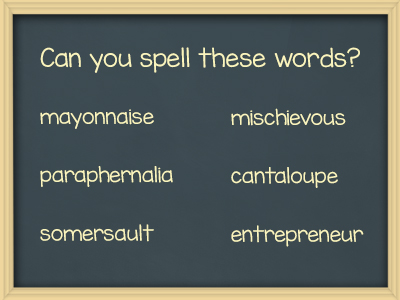
You didn’t have any trouble reading them, did you?
But what if I asked you to spell them? (Without looking first, of course!) How would you do?
If you think you would have spelled all these words correctly, congratulations! You’re probably a better speller than most adults. Though most adults can easily read these words, many would misspell them.

With a basic understanding of phonics, a child should be able to read the word special without much trouble. But spelling the word special is a greater challenge because of that tricky /sh/ sound in the middle of the word.
See what I mean? Is it any wonder that so many children struggle with spelling? And that leads to the second reason we teach reading and spelling separately.
When you try to teach your child to read and spell the same words at the same time, you guarantee only one thing: one of these critically important subjects will fall by the wayside. That’s because there are two possible scenarios with programs that combine reading and spelling:
Scenario #1. Your child learns to read the words in the lesson, but he can’t move on to the next lesson because he’s still learning to spell those words. Without knowing it, you have chosen to focus on spelling at the expense of reading.

Scenario #2. Your child learns to read the words in the lesson, but although he’s still learning to spell the words, you decide to allow him to move on to the next lesson. You’ve chosen to focus on reading, so your child’s spelling suffers.

As you can see, it’s a no-win situation. All-in-one programs force you to choose one subject to the detriment of the other. But I don’t believe you should have to sacrifice your child’s learning in any subject.
With our single-subject approach, your child can succeed at both subjects. He can progress as quickly as possible in reading …

… and he can take as much time as he needs in spelling.

With this approach, your child can more easily achieve mastery in both reading and spelling, without sacrificing learning in either subject.
Do you think that teaching reading and spelling separately would make a difference for your kids?


Courtney
says:Hello, I just discovered AAR and AAS. My son is in first grade and we are using The Good and the Beautiful. I’m going to make the switch. Based off this article, would you suggest level 2 AAR over AAS? And if so, how or when do you incorporate two curriculums? Mid year? Or just focus on one? And how would you incorporate the two in the timing of the day?
Robin
says: Customer ServiceCourtney,
I’m happy to help.
First, please know that our levels are not grade levels. The levels don’t correlate to specific grades because the order of the words in All About Reading is not in “grade-level” order. For example, All About Reading Level 1 covers words you will often see on 1st through 4th-grade lists but doesn’t cover other words on those same lists. So there’s not really a good way to compare. All About Reading groups words logically based on similar rules or patterns regardless of their supposed grade level, which allows students to progress quickly and confidently.
At the end of Level 4 of All About Reading, the final level, students have the phonics and word attack skills necessary to sound out high school-level words, though they may not know the meaning of all higher-level words yet. Word attack skills include things like dividing words into syllables, making analogies to other words, sounding out the word with the accent on different word parts, recognizing affixes, etc.
In addition, All About Reading includes research-based instruction in all aspects of reading, not only phonics and decoding skills but also fluency, automaticity, comprehension, vocabulary, and lots and lots of reading practice. Many children completing early levels of other programs have great decoding skills, but they are fluent or automatic in their reading yet. This would mean they need a lower level of All About Reading so they can develop the fluency needed to be ready for a higher level.
We have a reading placement test to help you determine which level of All About Reading your son will need. After you go through it with your son, let me know if you have questions or need help with placement. I’m always happy to help.
Then, placement for All About Spelling is separate from reading placement. Here is the spelling placement test. Most students need to start with Level 1 of this program, although occasionally some can skip Level 1 and start with Level 2. The placement test covers the Level 1 topics so you can know if your son needs to use Level 1 to solidify his foundational skills and knowledge to be ready for higher level spelling.
For example, we find that many students simply memorize easy words like “cat” and “kid” but have no idea why one uses a C and the other uses a K, or that the same rules that apply to these words also apply to higher-level words such as “concentrate.” Other students switch letters or leave out letters entirely. This usually occurs because they don’t know how to hear each sound in the word. Level 1 has specific techniques to solve these problems.
_______
Then, regarding incorporating both All About Reading and All About Spelling into your day, we recommend working on each for 20 minutes a day 5 days a week. Instead of trying to line the levels up in any way, we recommend that you take each subject at your child’s pace. Start each subject with a few minutes of review, and then pick up wherever you left off previously. This way, you can spread a lesson over as many or as few days as your child needs. Students still get the benefit of having spelling reinforce reading without being held back in reading or moving ahead too quickly in spelling.
You might like these blog articles that show examples of what your day might look like for each subject:
How Much Time Should You Spend On Reading?
A Typical Day with All About Reading
Spelling: How Much Time Should I Spend?
A Typical Week with All About Spelling
_______
I hope this clears some things up for you, but please let me know what additional questions you have. I’m here to help! If you prefer, however, you can also reach me at support@allaboutlearningpress.com
Kristal
says:I find it easier to teach spelling and reading separately; however, on tough days we choose a read a loud.
We are currently working through silent e and it’s taking some time, but I have confidence that my students will get it and we can move forward.
The funnel is a real thing and if my student has too much in the funnel we need to pause for the day.
Robin
says: Customer ServiceSounds like a great approach, Kristal. Wonderful work keeping your student’s learning funnel in mind!
Samantha W
says:We tried a combined curriculum and my son hated where we got to the spelling parts. This explains a lot. I really glad I switched to this curriculum.
Robin
says: Customer ServiceSamantha,
Thank you for sharing your son’s experience. I’m glad the switch is working out well for you!
Alf
says:Interesting. This was basically my conclusion last year. About halfway through, I gave up on spelling in favor of reading, and my first grader’s mastery really took off. This year we will backtrack to work on spelling separately.
I grew up with a phonetic language with clear rules for spelling (one letter = one sound) so having to teach English spelling has frankly been painful. The number 1 English grammar rules in our house is “English language is sneaky and tricky”.
Robin
says: Customer ServiceThank you for sharing your experience with needing to stop trying to match spelling to reading! This is true for so many students.
About a hundred years ago, there was a movement to change English spelling so that it too become one phonogram = one sound. Unfortunately, however, it didn’t get far and English remains “sneaky and tricky.” However, despite the trickiness, the vast majority of English follows predictable patterns and rules.
Diane
says:I definitely agree with you! Reading is difficult for many students. Some are not even pronouncing the words correctly. Spelling needs to wait until a child is ready and able to handle the task.
Robin
says: Customer ServiceGreat points, Diane. Thank you.
Shelby Cleland
says:Can’t wait to start teaching with the new level 1!!
Robin
says: Customer ServiceGreat, Shelby! Let me know if you have questions or need anything. I’m happy to help.
Priscilla
says:I appreciate your well thought out plan for separating the AAR with AAS. But is there not a way to sell them as a bundle as well? Rather than the individual curriculums?
Robin
says: Customer ServiceInteresting suggestion, Priscilla! Thank you. I’ll pass that along to the team.
Although, how they are bundled would be difficult to work out. Most students start All About Spelling Level 1 as they start All About Reading Level 2, so that would work. However, it’s somewhat common for a child to finish All About Spelling Level 1 and start Level 2 before they are ready to start All About Reading Level 3. Then, of course, there are just 4 levels of All About Reading to the 7 levels of All About Spelling, and almost all children finish All About Reading a year or more before they finish All About Spelling.
Kristen T
says:I love that you broke down the why for this method. Starting our second year of homeschool and I’m considering introducing spelling this year. Last year we focused on sight words and reading. I felt it necessary to focus on that first. I’m so glad I was following your method without even realizing it!
Robin
says: Customer ServiceI’m glad this was helpful for you, Kristen! Sounds like you are off to a great start with homeschooling.
Maria R
says:This is exactly what we’ve experienced with other “combined programs” for my daughter with special needs! Spelling has been challenging and we’ve often had to “move on” before her fluency has caught up. I was an early childhood special education teacher and love that reading and spelling are two separate programs. We’re excited to give All About Spelling a try this year!
Robin
says: Customer ServiceMaria,
I’m sorry your daughter has struggled with combined reading and spelling programs. All About Spelling should be just the thing to allow her to move at her own “just right” pace for success! Let me know if you have questions or need help with placement or anything else. I’m happy to help!
Lisa
says:That makes so much sense! Reading does generally come first for many students.
Robin
says: Customer ServiceThank you, Lisa. Yes, most students move ahead in reading much more easily than spelling. A few, however, find spelling easier at first, and learning to spell words helps them read more fluently. It’s just so important to teach each child each subject at their own unique pace.
Typhanie
says:Such a great analogy of adults recognizing the word but not easily spelling it. As a dyslexic and hyperlexic person and noticing it in my son, it’s great we can be at different levels or lessons
Robin
says: Customer ServiceTyphanie,
Oh, yes! It’s more common than most people think to have a child that is very behind and struggling with spelling to be doing very well at or above level in reading. It’s so important to be able to teach students where they are at.
E.M. Peters
says:Wondeful program
Holly
says:Very interesting! Yes I think this would help to separate the two!
Kate Ihme
says:This was interesting and makes a lot of sense.
Robin
says: Customer ServiceThank you, Kate.
Julie
says:Thanks for this. Very informative and exactly what I needed.
Vasha
says:As a second grade teacher I prefer the all in one teacher strategy for reading and spelling. Students are able to learn how to write sentences as well as read them too.
Stephanie
says:Thanks so much for this. It’s so interesting, but exactly what I’ve found. Last year, my son and I did another LA all in one program and his reading progress was great, but his spelling was not keeping up at all, leading to some tears. We are starting AAR 2 and AAS 1 this year.
Robin
says: Customer ServiceStephanie,
I’m so sorry to hear that tears were involved in your son’s learning previously. I hope All About Reading and All About Spelling are a much better experience for you both!
Stephen Kaufman
says:Do audio books impede a child’s learning to spell or to read?
Thank you.
Stephen
Robin E.
says: Customer ServiceNo, not at all, Stephen! Audiobooks are great options that can aid children’s learning to read. Our blog post on 4 Great Ways to Build Listening Comprehension lists listening to audiobooks as one of the four ways to build listening comprehension and discusses how listening comprehension is related to reading comprehension.
ALICE
says:I love this site and while I have learned much on this site, I teach Reading and Spelling simultaneously. I actually teach reading by Phonics first, and as soon as they learn to read their first decodable book (level one), they are given a spelling test of short vowel words and almost always gets 100 percent correct. I have done this year after year with ages 5 years old to 81 years old. We then move on to words with long vowel sounds CVCV and CVVC words. Same results as above.
Paulla Boatman-Jankowski
says:This is excellent information!!
Robin E.
says: Customer ServiceThank you, Paulla!
Tara Johnson
says:So Do we complete the reading program first then purchase spelling, or can they do both but at different times of the day or alternating days? What do you recommend?
Robin E.
says: Customer ServiceThat’s a great question, Tara!
We recommend students complete All About Reading Level 1, or the equivalent reading level, before starting All About Spelling. We discuss this in our The Right Time to Start Spelling blog post.
But once a student has finished All About Reading Level 1, we recommend working in both reading and spelling each day. Just 20 minutes of reading a day and just 15-20 minutes of spelling are needed to make great progress!
Start each subject with a few minutes of review, and then pick up wherever you left off previously. This way you can spread a lesson over as many or as few days as your child needs. Students still get the benefit of having spelling reinforce reading without being held back in reading, or moving ahead too quickly in spelling.
You might like these blog articles that show examples of what your day might look like for each subject.
A typical day and week for All About Reading
A typical day and week for All About Spelling (This one is of an older student using a higher level, but it still shows how you can break a lesson up over several days or a week.)
I hope this clears things up for you, but please let me know if you have additional questions or need anything else. I’m always happy to help!
Cindy
says:This explains the difference very well. Thank you!
Robin E.
says: Customer ServiceYou’re welcome, Cindy!
Jane
says:I definitely believe that spending a few moments on the two separate subjects is best taught separate.
Cathleen
says:I also find that teaching reading and spelling at the same time makes them frustrated as well.
Robin E.
says: Customer ServiceSo true, Cathleen.
Patty
says:I can’t wait to learn more about your products!
Robin E.
says: Customer ServiceDo you have any questions, Patty? Let me know. I’m happy to help!
Ariana
says:Thank you, that makes sense!
Robin E.
says: Customer ServiceYou’re welcome, Ariana!
Nicole Merrick
says:Separating reading from spelling has been so helpful for my twin boys who were both recently diagnosed with dyslexia and ADHD. They are making steady progress and gaining confidence! Thanks for such a great program!
Robin E.
says: Customer ServiceI’m so pleased to hear that your boys are making progress and that it is related to separating the instruction of reading and spelling. Thank you for sharing, Nicole!
Lindsay Johnson
says:Love this approach! My daughter is so excited to start AAS this month!
Haley
says:Thank you! This makes perfect sense to keep them separate and let the child progress in each one at their own pace.
Robin E.
says: Customer ServiceYou’re welcome, Haley! Yes, most children make the best progress when they can work on each subject separately.
Mary Bedel
says:We just began AAS1 after finishing AAR1, and our daughter is already enjoying spelling more than reading. I can see that the spelling is coming easily because of all the work we put into reading in decoding the words, but given her level of enjoyment, I wonder if it’s possible to move ahead in spelling and have reading taught after. Is that a possibility now or should we keep the order of reading concepts first?
Thank you!
Robin E.
says: Customer ServiceMary,
At this point, we recommend working in both All About Reading and All About Spelling each day, separately. Allow your daughter to progress at her own pace in each, and if that means she gets ahead in spelling, that’s fine! It doesn’t happen often, but it works out that way for some children.