
Search
Vocabulary plays an important part in learning to read. For example, when a beginning reader sees the word dog in a book, he begins to sound it out. When he realizes that he is very familiar with the word dog, he reads it with confidence.

But what if the child comes across the word yak in a story? If he has never heard of a yak, he may try to sound out the word, but may then begin to second guess himself. Is this a real word? Have I decoded it properly?
A similar thing can happen with older students, too. If a student comes across the word bovine but it’s not in his vocabulary, he may become frustrated.
A large vocabulary is critical for reading comprehension. This article will show you how to include vocabulary development in your child’s educational plans, as well as some pitfalls to avoid.
When we talk about vocabulary, we are actually talking about four related vocabularies. In order from largest to smallest they are:
For younger students who are still learning to read, speaking vocabulary is generally larger than their reading vocabulary. But for older readers who are past the “learning to read” stage and who have entered the “reading to learn” stage, this is the typical order.
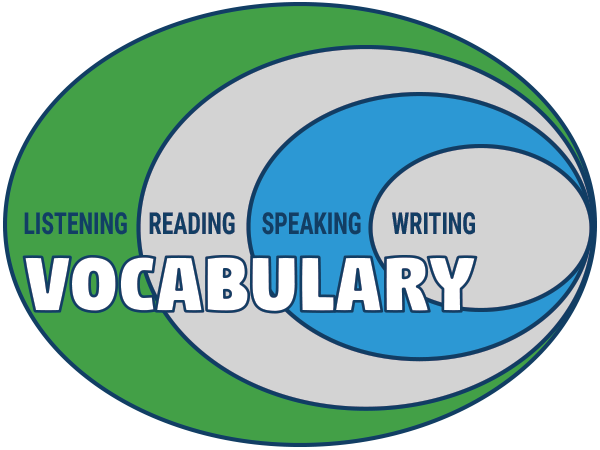
There is a high correlation between the four vocabularies. Growth in one area generally leads to growth in another. But is it possible for you to influence this growth? The simple answer is YES!
So let’s look at how to increase your child’s vocabulary.
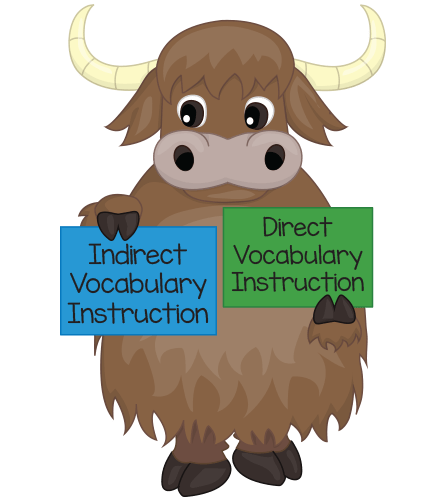
Both indirect and direct methods of building vocabulary are important, but let’s look at what doesn’t work when trying to build your child’s vocabulary.
Does this routine sound familiar?
It’s Monday–time to learn a new list of twenty vocabulary words. The children look up the words in the dictionary and copy the definitions. On Tuesday they will use the words in a sentence, and on Wednesday they will complete a fill-in-the-blank worksheet or even a fun vocabulary crossword puzzle. On Friday there will be a quiz on the twenty words. Then, whether they remember last week’s words or not, on Monday it will be time to start all over again.
Although many of us were taught vocabulary words this way, even the most compliant kids groaned inwardly at this demotivating routine.
Here’s the problem: the list-on-Monday, test-on-Friday approach to teaching vocabulary simply isn’t effective. It does, however, illustrate these common mistakes:
And then there is a fifth common mistake:
And this is really where the rubber meets the road. Vocabulary that is developed naturally rather than taught using the more traditional method above is much more likely to stick with your child.
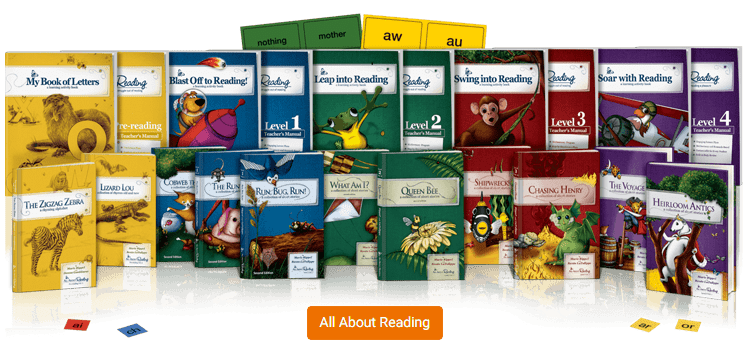
Each story lesson in the All About Reading program includes direct and indirect vocabulary lessons that offer a variety of ways for your child to learn new words. The sampling below shows the range of vocabulary-building activities that can be found in AAR lessons.
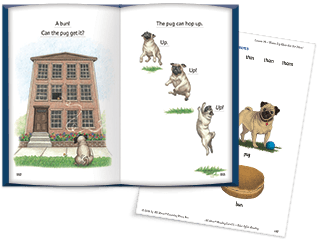
Though this is perhaps the simplest type of vocabulary lesson, it is effective because it allows children to form pictures of concrete nouns in their minds. In this AAR Level 1 example, students are introduced to the words pug and bun before encountering the words in the story “Get Them!”
Download the Warm-Up Sheet from Level 1
Download Level 1 Story: “Get Them!”
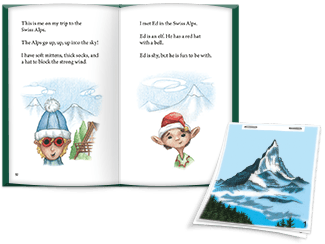
This AAR Level 2 lesson introduces children to the mountain region of the Swiss Alps with an easy-to-make minibook and an engaging story.
Download a minibook activity from Level 2
Download Level 2 Story: “An Elf in the Swiss Alps”
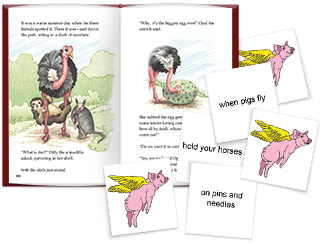
AAR Level 3 introduces twelve idioms in an activity called “When Pigs Fly.” Many of these idioms are encountered in “Chasing Henry” and subsequent stories.
Download an idiom activity from Level 3
Download Level 3 Story: “Chasing Henry”
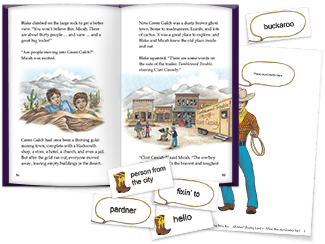
The AAR Level 4 activity “What Does the Cowboy Say?” introduces children to vocabulary and regional idioms such as reckon and fixin’ to, which in turn allows them to fully enjoy the story “Cowboy Star.”
Download a dialect activity from Level 4
Download Level 4 Story: “Cowboy Star”
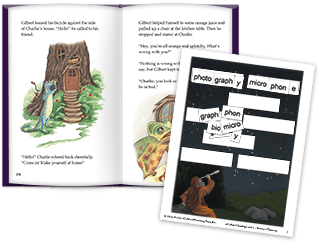
And finally, AAR Level 4 includes an activity called “Borrow a Telescope” that introduces children to eleven common Greek word parts and related vocabulary words. Some of these words are featured in “Charlie’s Sick Day” and subsequent short stories.
Download a word building activity from Level 4
Download Level 4 Story: “Charlie’s Sick Day”
Other vocabulary activities feature homophones, concept maps, morphemic strategies, and words that have origins in other languages such as French, Spanish, and Italian.
Research shows that children also learn a huge number of words from engaging in conversation with the adults around them. So as a parent, how can you leverage this knowledge for your child’s benefit?
The conversational method is a powerful way to help build your child’s vocabulary. It is an indirect method that is so simple that you can start using it right after you read this article.
In a nutshell, the conversational method is simply talking with your child and expanding upon vocabulary words that your child has not yet learned.
Step 1: When a new word comes up in conversation or in a book, provide a simple, age-appropriate definition for the new word.
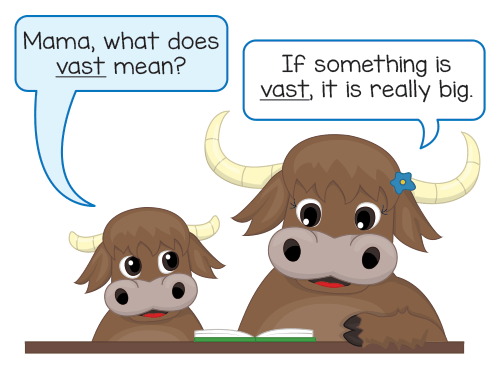
Step 2: Provide one or two examples that make sense to your child.
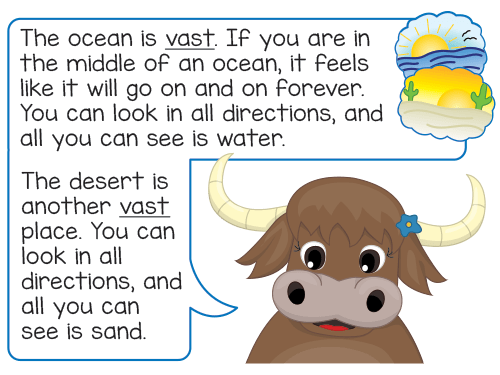
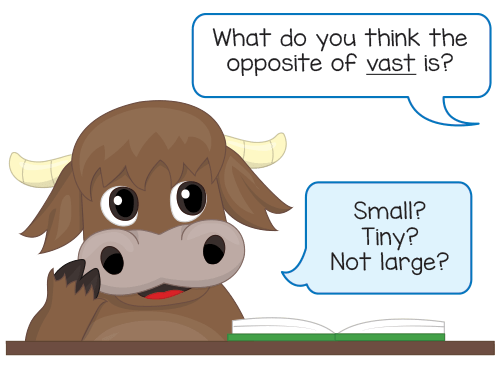
Step 3: Encourage your child to think of his own example, or of the opposite of the new word.
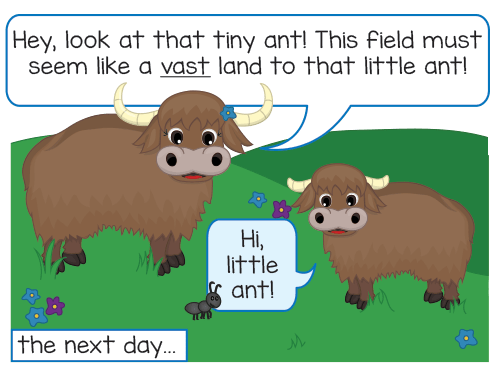
Step 4: Use the new word in conversation over the next few days.
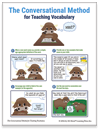
You can download this simple chart and hang it on your fridge to remind yourself of the four steps. Soon this method will become second nature to you, and your child’s vocabulary will grow by leaps and bounds.
All About Reading is a research-based program, and I spend considerable time keeping up on the latest language arts-related studies. My job is to ensure that we’re doing everything we can to help children learn to read. There is a large body of research that backs up our claim that vocabulary growth is critical for reading, especially as students approach high school.
When it comes to building your child’s vocabulary, here’s what you need to keep in mind:
The All About Reading program walks you and your child through all the steps needed to help your child’s vocabulary grow. The program is multisensory, motivating, and complete, with everything you need to raise a strong reader. And if you need a helping hand, we’re here for you.
What’s your take on encouraging a larger vocabulary? Have anything else to share? Let me know in the comments below!


Monica
says:As a homeschooling mama, I am always looking for new approaches to teaching my child & I like all of the suggestions here for expanding her vocabulary. She is 8 & reading at an upper middle school level, but these are all great ways to make sure her vocabulary is developing alongside the reading. Thank you for the great resources!
Robin
says: Customer ServiceYou’re so welcome, Monica! I used this approach to vocabulary with my kids and it was very effective!
Fatimah Balogun-Agbaje
says:This has been helpful. I am going to share it my teachers. Thank you. Please can I get some links specifically designed to teach vocabulary through movies.
Robin
says: Customer ServiceI’m glad this will be helpful, Fatimah!
I’m not aware of any links or sources specific to teaching vocabulary through movies. However, the approach for movies will be much the same as outlined here, a discussion based approach. A teacher could pre-watch the movie, noting any vocabulary he thinks his students may not know yet. Then he can briefly pre-teach the words before the students watch the movie, using the techniques shown in this article. Then, after the movie, go over the words again, bringing up the context of what was happening when the words were used. The teacher should also use the words and encourage the words to be used by the students over the next few days.
Note, I said “words” but it will be important not to do more than a few. Too many at once will just result in the students not remembering them all. This has to do with How the “Funnel Concept” Affects Learning.
I hope this helps some!
Theresia Anderson
says:Excellent. Thank you so much for sharing. I’m excited to use some of your material
Robin
says: Customer ServiceGreat to hear, Theresia! Thank you.
Kathrine
says:Great article! Thank you for that.
How does AAR correlate with the new Science of Reading approach coming out for schools? Our state will start implementing it this July.
Robin
says: Customer ServiceGreat question, Kathrine!
Both All About Reading and All About Spelling are research-based programs that align with the Science of Reading. They both are based upon the Orton-Gillingham approach.
Additionally, the programs incorporate the findings of the National Reading Panel (2000) (Teaching children to read: An evidence-based assessment of the scientific research literature on reading and its implications for reading instruction. Washington, DC: National Institute of Child Health and Human Development.)AAR addresses the five components of reading as identified by the National Reading Panel (phonological/phonemic awareness, phonics, fluency, vocabulary, comprehension).
In addition to the five components of reading, oral language and listening comprehension are addressed.
Instruction is explicit.
– Teacher directives are highly detailed.
– Instruction is systematic. There is a prescribed order of introducing specific skills within each component of reading.
– There is cumulative review in all instructional areas.
– Decodable texts are read before trade books.
– There is explicit instruction in irregular words and decoding strategies.
Please see our blog article, 12 Reasons Teachers Love All About Reading and All About Spelling where you can read more about the research-based methods that All About Reading and All About Spelling incorporate.
I hope this helps! Please let me know if you have additional questions.
Kimberly Treon
says:I love this! Thanks for sharing this awesome resource!
Robin
says: Customer ServiceYou’re welcome, Kimberly!
favour
says:goodevening pls i have a 10years old and 8 years i need help teaching them vocabulary pls how can i start they are in 4th gread and 2nd gread pls i need help thanks
Robin
says: Customer ServiceThe tips in this blog post will help you teach vocabulary to your children. Look for ways to expose them to new words, such as reading books to them, watching a video uses more complex language, or something like that. Then use the word with them. Talk about its meaning. Encourage each other to use the word over the next few days.
Laurel
says:I can’t wait to start this in the new year. Thank you
Robin
says: Customer ServiceYou’re welcome, Laurel!
YaadStyle Homeschooling
says:This is so informative and eye opening. I thought that there was only one type of vocabulary.
Robin E.
says: Customer ServiceI’m glad this was informative for you!
Martha
says:My son is sneaky. If he does not understand a word when reading he just lets it slide by, without asking. Often at the end of a story he lacks comprehension due to vocabulary.
Now in fourth grade now I am finally catching on that if he is stumbling reading a word, he probably does not know what it means.
Robin E.
says: Customer ServiceMartha,
It’s fairly common for kids to just keep reading when they encounter a word they don’t know. It’s just easier. That is why pre-teaching vocabulary before reading can be so effective.
Martha
says:My son is sneaky. He has a pretty good vocabulary, but if he does not understand a word when reading or being read to he just lets it slide by, without asking. Often at the end of a story he lacks comprehension due to vocabulary.
My son is in fourth grade now and I am finally catching on that if he is stumbling reading a word aloud, he probably does not know what it means. This has helped me stop and teach vocabulary when needed.
My son has a learning disability that makes him less likely to just pick up meaning from context. But, he was only recently diagnosed.
I hope my comment may help another parent whose child is just sneaking by.
Vanessa Hoque
says:I cant wait to try this techniques and read materials to my child
Robin E.
says: Customer ServiceSounds great, Vanessa!
Angelia Bauer
says:Thank you for the vocabulary tips!
Robin E.
says: Customer ServiceYou’re welcome, Angelia!
Janet Hanmer
says:I love the way d and b are taught!!
Robin E.
says: Customer ServiceThank you, Janet!
Sue Slezycki
says:This sounds like a great program.
Robin E.
says: Customer ServiceThank you, Sue!
Jay
says:Excellent article on building vocabulary. I always wondered about whether specific curriculum was necessary as we were using Wordly Wise just for fun for both our 4 and 6 year olds. AAR has been wonderful for us (and we read, read, read every day-together and now my 6 year old, who’s halfway through Level 3, reads to her brother!) and they both have a great vocabulary, I’m positive, in part to AAR! We love y’all!
Robin E.
says: Customer ServiceWow, your 6-year-old is doing so well, Jay! Wonderful work! And that read, read, read every day plays a huge part in vocabulary development!
BRIGID O'HAGAN
says:thank you!
Robin E.
says: Customer ServiceYou’re welcome, Brigid!
Jane
says:I’m so glad I came across this blog post! I love the examples and books provided and other resources! I will be a first time homeschool mom and I am soaking up all the info/encouragement/resources I can get my hands on! It’s been a great search.
Robin E.
says: Customer ServiceI’m so glad this is helpful for you, Jane! But if you have any questions or need anything, just know we are always happy to help!
Kelly
says:Great ideas. My daughter is an excellent reader, but struggles in vocabulary so this is very helpful.
Robin E.
says: Customer ServiceI’m so glad this is helpful, Kelly!
Jacqueline
says:This is such a great way to explain effective vocabulary instruction. Thank you!
Robin E.
says: Customer ServiceYou’re welcome, Jacqueline. Thank you!
Sonya Haidet
says:Mine are excited about the dictionary now!
Robin E.
says: Customer ServiceGreat to hear, Sonya! More traditional approaches to vocabulary can make children hate dictionaries. I love that this approach often leads to children enjoying dictionaries.
C
says:Good ideas
Robin E.
says: Customer ServiceThank you.
Sydney
says:A lot of good ideas in here that I’m excited to utilize- glad I clicked on one of the links that suggested the Apples to Apples Jr. game as a fun way to do this. We love family games and I think my kids will really enjoy this one (and learn more words along the way😉).
Robin E.
says: Customer ServiceI’m glad you are excited about the ideas in this blog post, and about playing games for building language skills. Thank you, Sydney!
Susan
says:This blog is very informative. Thank you!
Robin E.
says: Customer ServiceYou’re welcome, Susan! I’m glad it’s helpful!
Heather
says:What a great way to add to our childrens’ vocabulary!
Robin E.
says: Customer ServiceThank you, Heather!
Amanda Mobley
says:Daily conversations and read alouds! Can’t believe our son is close to being five, I’m excited to teach him to read.
Gretchen N
says:I have always found those weekly lists for vocabulary and spelling to be so tedious and my kids never enjoyed them. AAR has been a breathe of fresh air!
Robin E.
says: Customer ServiceGreat to hear it, Gretchen!
Jennifer O
says:I love AAR and AAS! I’ve used it on our last child for homeschool. Sure wish it had been around for the older two…
Michelle salazar
says:Love this!
Erica Stoltzfus
says:Love this post. So many good ideas for building a larger vocabulary in smaller children. I personally like reading aloud to them to grow a larger vocabulary from the time they are babies. We don’t just read picture books, we also do many non fiction books about topics they are interested in. That way they are getting introduced to so many topics and growing their vocabulary.
Stephanie Lowe
says:I have noticed a huge difference in my kids vocabulary after the first 10 lessons!